Understanding State Testing: South Carolina Edition [Updated]
"Results are in for South Carolina's annual test of reading and math among elementary and middle schoolers, and scores are up across nearly every grade level for a second year in a row."

Just a few days ago, New York reported an unusually large drop in state reading scores, despite having adopted “science of reading” legislation similar to over 40 states in the US recently.
The news out of South Carolina about 2026 state testing is much different:
Proficiency rates vary from grade to grade and district to district on the annual SC READY test, which was administered in elementary and middle schools last spring, but the trend is up for all students in grades three through eight in reading — with 61.3 percent testing at or above grade level statewide in 2026. This is a significant improvement from two years ago, when students met or exceeded expectations at a rate of 53.5 percent. (That rate rose to nearly 60 percent in 2025.)
The truth about NY and SC scores—as well as the impact of new reading legislation, reading programs, and teacher training—is extremely complicated, and people in both states would be better served if media and political claims about either lower or higher scores are taken with a (huge) grain of salt.
Let’s look at two aspects of SC that tell a different story about reading scores increasing over the past two years.
First, like almost every state in the US, SC reading proficiency is set within the range of NAEP “basic” (NAEP “proficient” is much higher than state “proficient”). However, SC has shifted from having one of the highest levels for “proficient” (near the top quartile of states in 2015 [235]) to being in the bottom six states by 2022 (218):
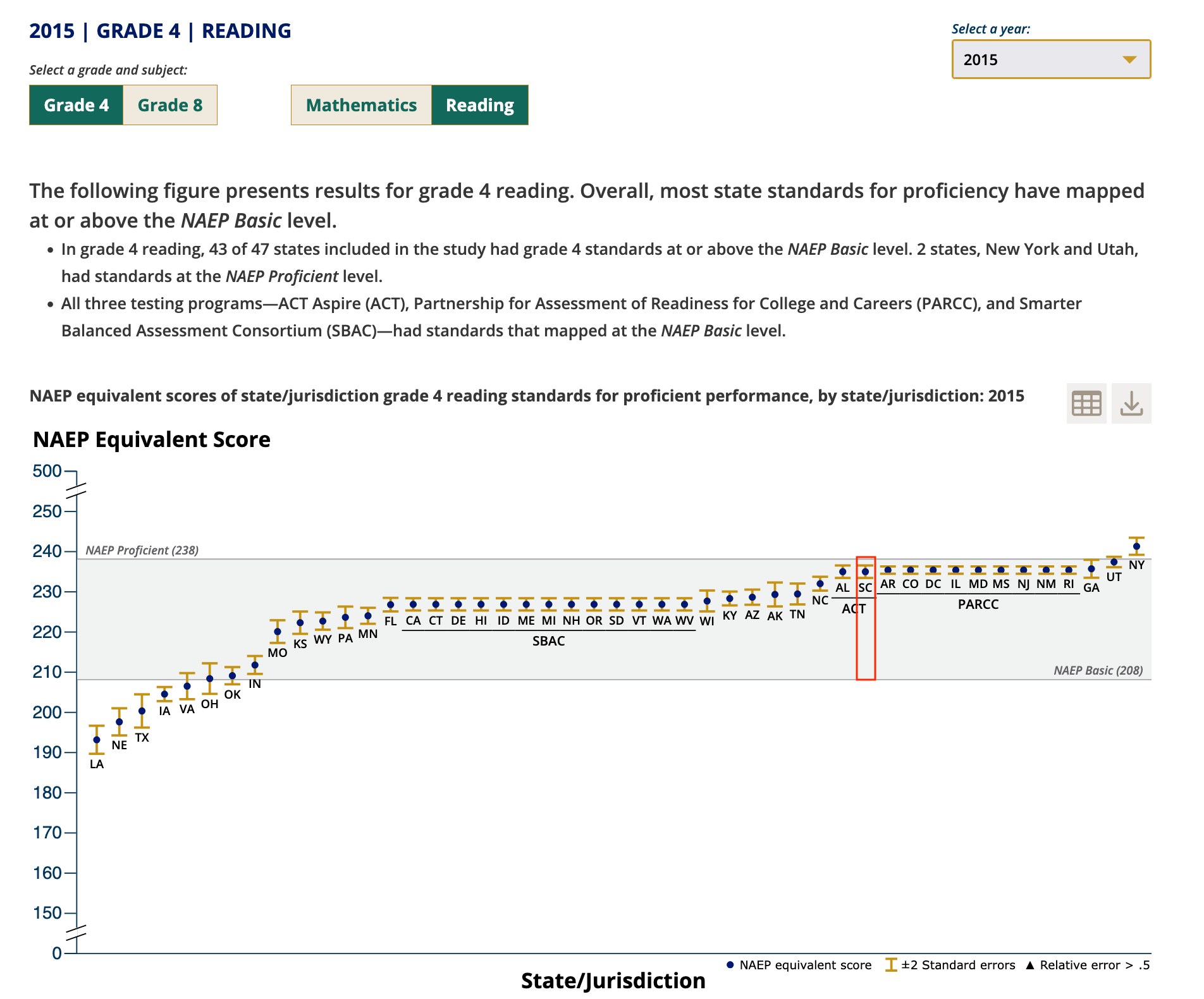
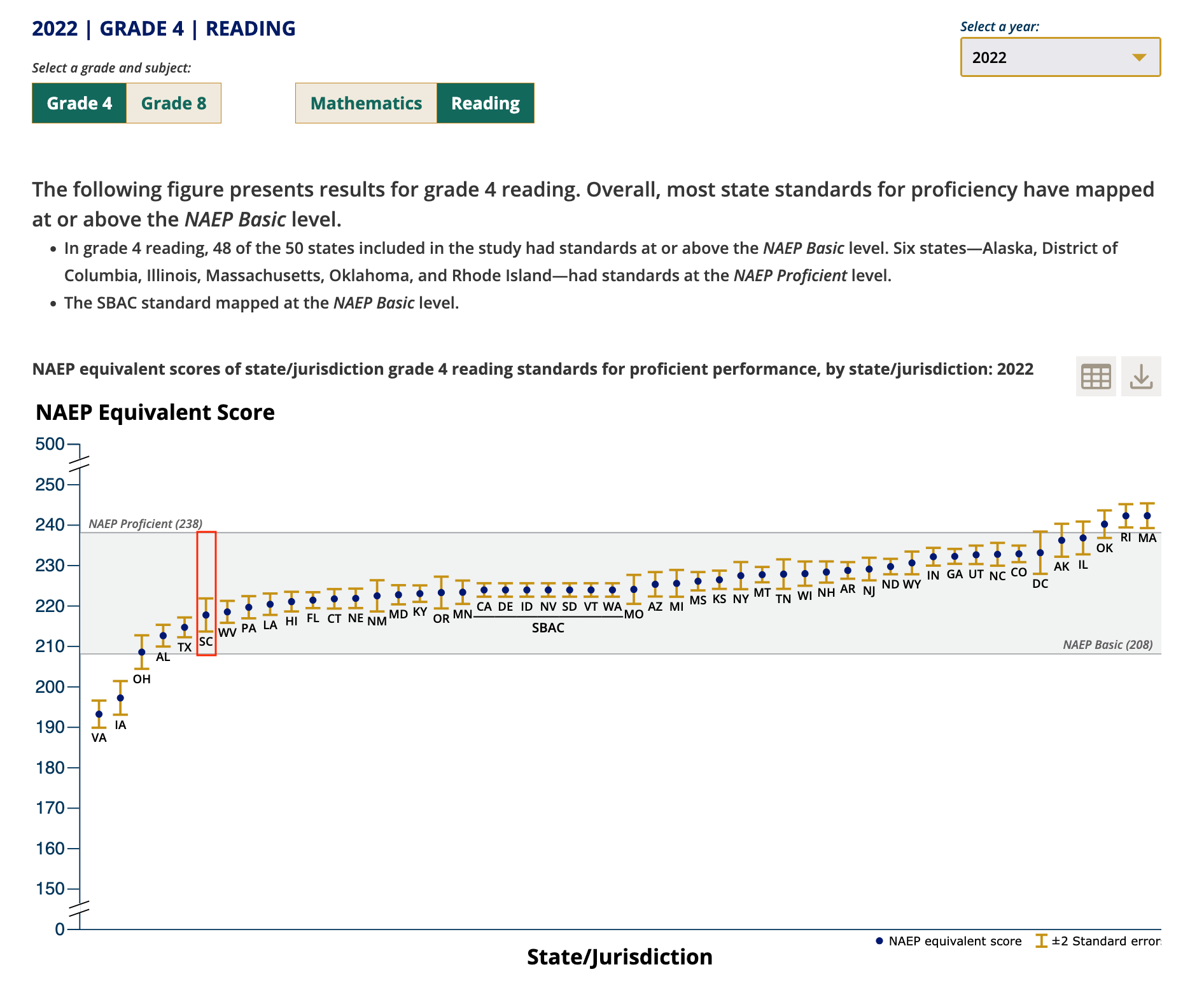
States are free to set their own proficiency scores, and thus, when states see increased or decreased test scores, that may be, in part, a function of changing proficiency cut offs—not a reflection of teaching or learning. [1]
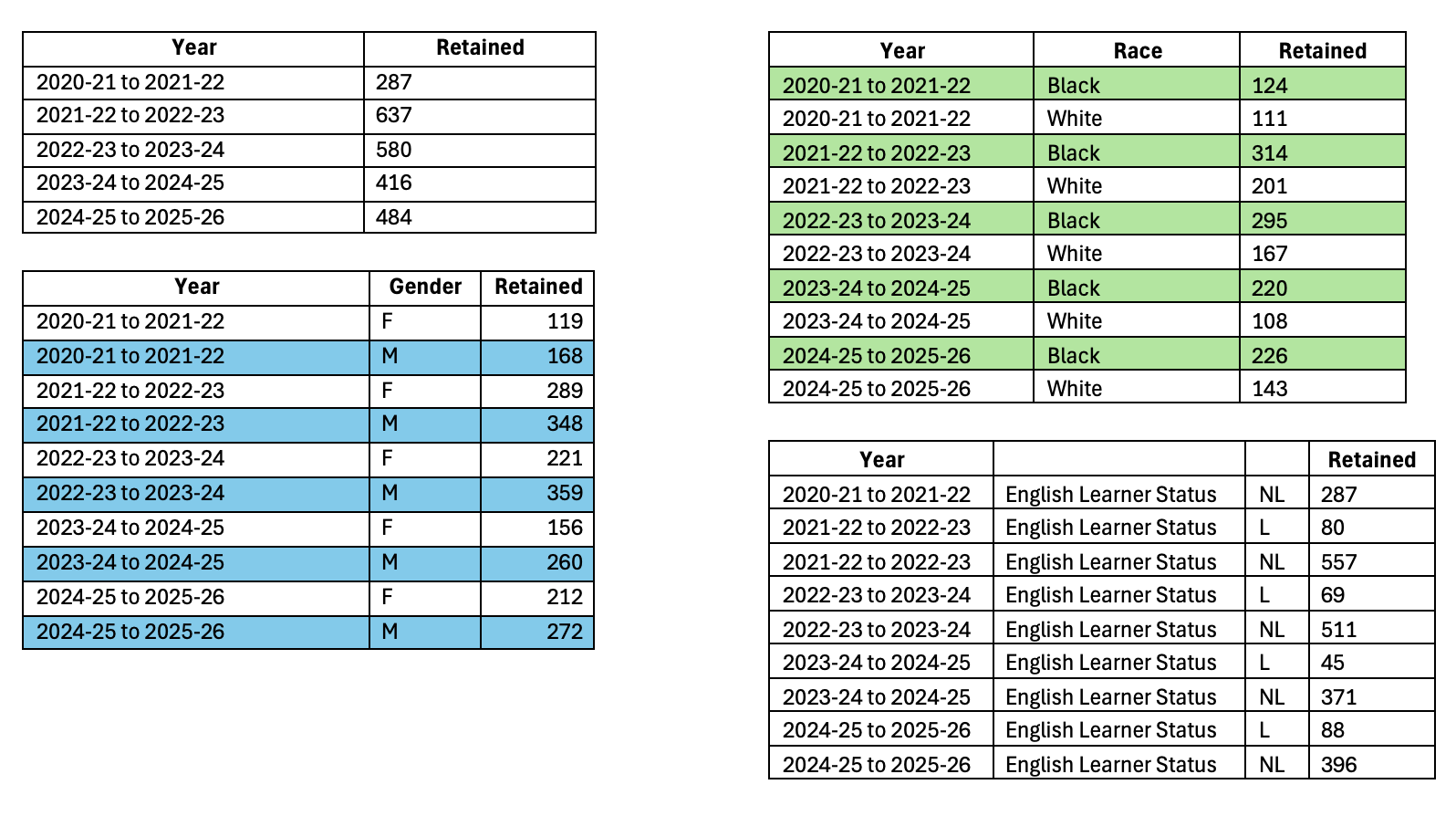
Likely a more significant caution, however, is that like Mississippi and Florida, SC has chosen to jump on the grade retention bandwagon. In fact, SC has seen a significant increase of students being retained [2]:
More South Carolina students had to repeat the third grade this school year because of a 2024 law that revamped the state’s elementary literacy education system, public data shows.
Schools held 1,281 third graders back after the 2024-25 school year when the law went into effect, compared to 424 a year earlier, according to figures provided by the S.C. Department of Education.
That increase means about 2 percent of the third graders enrolled in public schools last year had to take it again this year, even as the grade’s overall English scores increased.
At least four recent analyses [3] of state reading policy and why some states (such as MS) have seen grade 3 and 4 test score increases show that those increases are the result of retaining the lowest scoring students, thus manipulating the test score data.
In short, higher state reading scores in states with high levels of grade retention likely do not represent increased student learning, but statistically inflated scores.
The politics around the increased scores in SC should also raise some red flags since the announcement is centered on a large charter chain in the state—a darling of the Republican administration.
SC raising state test scores is little more than fodder for partisan political grandstanding.
As a result, students, teachers, and public education are being once again failed.
[1] Critics say Oklahoma damaged trust, failed students by quietly lowering testing rigor
[2] Here is official SC grade 3 retention data from the SC DOE. Data show that retention disproportionately impacts Black (SC student population is about 48% white and 32% Black) and male students:
[3] See the following:
The Mississippi Miracle: Smoke and Mirrors vs. Reality, Daniel H. Robinson and Howard Wainer
Howard Wainer, Irina Grabovsky, Daniel H Robinson, On education miracles in general (and those in Mississippi in particular), Significance, Volume 23, Issue 1, January 2026, Pages 32–36, https://doi.org/10.1093/jrssig/qmaf098
Camilli, G. (2026). NEPC Review: Inside the Mississippi marathon. Boulder, CO: National Education Policy Center. https://nepc.colorado.edu/review/mississippi
Westall, J., & Cummings, A. (2023, June). The effects of early literacy policies on student achievement. Education Policy Innovation Collaborative. https://edworkingpapers.com/sites/default/files/ai23-788.pdf
If you want to help with the costs of keeping my public work open access and free, please DONATE.