Political Activism and Education: The Failure of Good Intentions
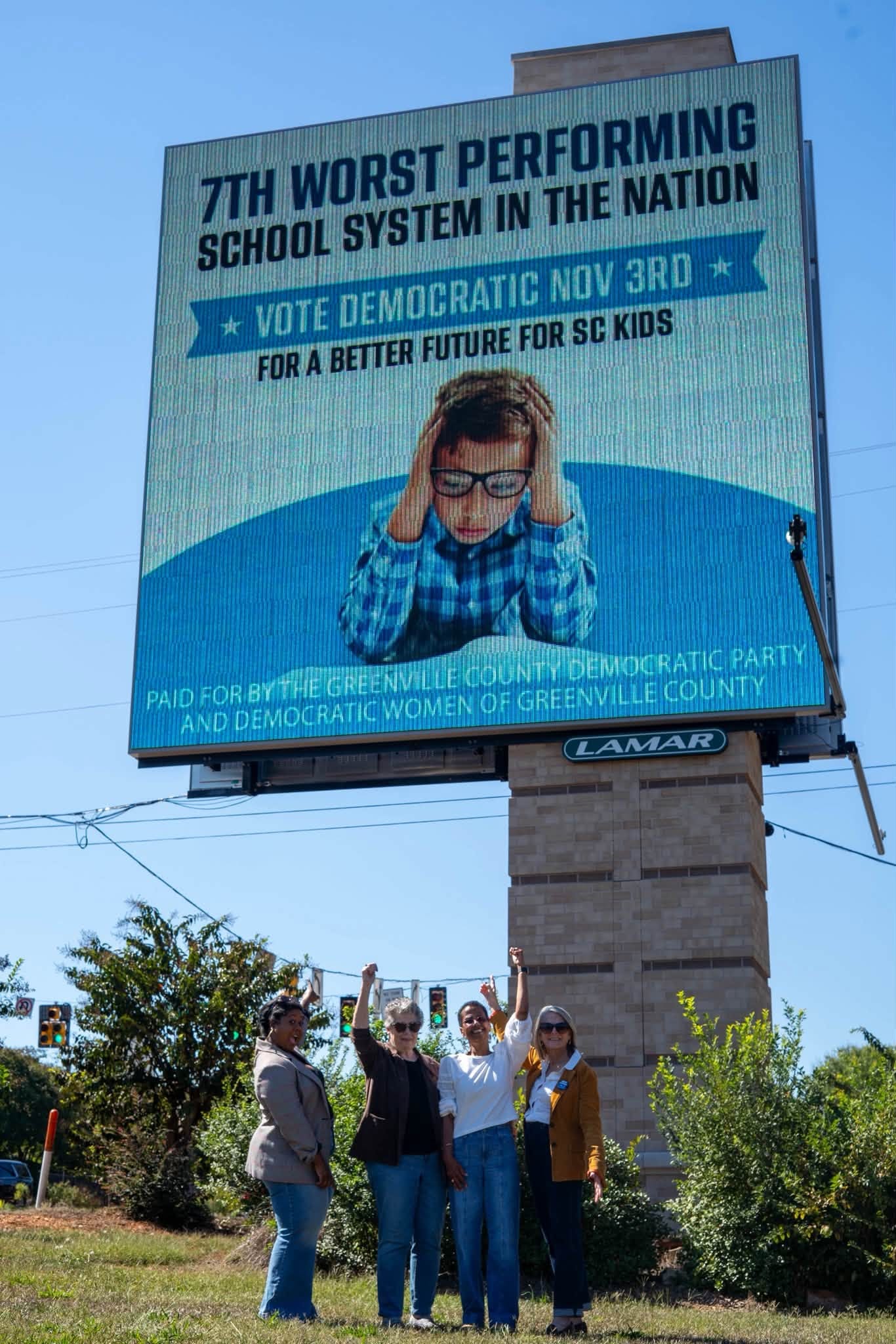
As a lifelong South Carolinian and educator in his 43rd year of teaching in the state, the image and post above causes me a great deal of angst.
Another billboard in that post asks, “23 Years of one-party rule left you feeling powerless?
And I am compelled to not just agree but scream, “Yes!” You see, over the course of 45 years as a SC voter, I have often stood in the voting booth with most of the elections having only one candidate, a Republican.
However, it is the billboard above that causes me distress because I have also witnessed over those years voting and teaching a perpetual story told by both Republicans and Democrats—SC (and US) public education is failing.
And that story results in an endless cycle of bi-partisan education reform that, frankly, is captured by Oscar Wilde: “But their remedies do not cure the disease: they merely prolong it. Indeed, their remedies are part of the disease.”
Yet again, these billboards demonstrate that good intentions are not enough.
Below, then, is an older post about SC’s education problem and one of my first scholarly articles from 1999.
After all, we are all victims of this culture of pragmatism; of its de-professionalization of the teaching professions; of its power to lure us away from a discourse of what ‘could be’ in education; of how it limits the education reform discourse to minor shifts in practice – Taco Night – that, despite good intentions, colonize more than they liberate.
Paul Gorski (2008)
South Carolina's Education Problem: Crisis, Faddism, and Boondoggles
One of my first scholarly publications, “A new honesty in education—Positivist measures in a postmodern world,” included the 1998 governor’s race in South Carolina between David Beasley (incumbent Republican) and Jim Hodges (Democratic) in a solidly Republican state.
While the governorship that election shifted to Hodges, mostly because of the wedge issue of gambling in SC, I noted that both candidates and political parties ran on a dishonest but effective platform—SC education was at the bottom in the U.S. In fact, both candidates had billboards lambasting the state’s education ranking that were virtually indistinguishable except for the candidate information.
In 2022 (and 2026), it is important to highlight that SC was popularly and politically identified in crisis and need of reform after two decades of crisis (A Nation at Risk under Ronald Reagan in the early 1980s) and a series of standards and high-stakes testing reform.
I entered education in 1984, right after then-Governor Richard Riley had pushed SC as one of the first adopters into the accountability movement.
As a high school teacher throughout the 1980s and 1990s, I watched and listened as SC political leaders called for modeling SC education policy, standards, and testing on Florida and Virginia (more recently, the model state is Mississippi); despite its bombastic libertarian proclamations (First to secede from the Union!), SC is copy-cat state when it comes to education policy.
And therein lies the problem.
SC remains trapped in a cycle of education crisis, education faddism, and education boondoggles.
Unfortunately, my experience and a growing body of scholarship on intercultural education and related fields (such as multicultural education, intercultural communication, anti-bias education, and so on) reveal a troubling trend: despite overwhelmingly good intentions, most of what passes for intercultural education practice, particularly in the US,accentuates rather than undermines existing social and political hierarchies.
Paul Gorski (2008)
After those two decades following A Nation at Risk, SC once again doubled down on reform and accountability during the No Child Behind Era (NCLB) under George W. Bush, and then, stumbled into the Obama era reforms—value-added methods for teacher evaluation, charter schools, and (yes) Common Core.
That Obama/Common Core era is a perfect example of educational dysfunction in SC.
SC rushed to adopt Common Core and the related testing (faddism), purchased teaching and learning materials labeled as Common Core aligned (boondoggle), and then while teachers were being trained and the entire educational system was transitioning to the new standards, SC dropped Common Core (because conservatives falsely labeled the movement as Obama’s although the standards came form the National Governor’s Association and were strongly bipartisan).
This wasteful nonsense was almost entirely partisan politics and had little to do with teaching and learning.
So as we stand in 2026, SC remains trapped in the crisis > faddism > boondoggle cycle that has been demonstrated to fail education since the early 1980s.
The accountability movement phase 1 (mostly a state-level movement) after A Nation at Risk was declared a failure and lead to the accountability movement phase 2 that pivoted on NCLB (and included federal policy mandating “scientifically based” teaching and materials).
About another 25 years after phase 2, we are once again screaming crisis, including a(nother) reading crisis and the really ugly anti-CRT/book banning movements (see how all of these are related historically).
SC has been quick to pass copy-cat reading legislation (see HERE and HERE) for about a decade, and the state budgets have included millions and millions of dollars for “science of reading” policy, training, and materials (sound familiar to those who watched the Common Core disaster?).
As one specific example, SC like many other states is simultaneously (again) calling for limiting everything in education to “scientific” while investing huge amounts of tax dollars to non-scientific boondoggles (see here about LETRS).
Education is an incredibly profitable market in the U.S., and the only people who have benefited from 40+ years of constant crisis > reform are those who repeatedly rebrand educational materials to match the fad-du-jour.
The current reading crisis and curriculum crisis in SC and across the U.S. are marketing and political scams—all faddism and boondoggles.
SC does not have a reading crisis, and never had a CRT crisis.
The real educational problems in SC (and throughout the U.S.) are once again being ignored—poverty, racism, and inequity in both the lives of children and citizens as well as in our schools.
Affluent children continue to have the best access to learning while marginalized and vulnerable children are neglected, ignored, or pushed into the most limited and limiting educational contexts (such as test-prep).
SC is not experiencing a new or unique educational crisis, but we are suffering from a historical and current reality that is reflected in our educational system—a lack of political will.
Crisis, faddism, and boondoggles are the playground of political leaders and education marketers who reap the rewards of misinformation, misdirection, and finding ourselves in a hole while continuing to dig.
Reference
Gorski, P. C. (2008). Good intentions are not enough: A decolonizing intercultural education. Intercultural Education,19(6), 515 - 525.
If you want to help with the costs of keeping my public work open access and free, please DONATE.