The Complicated Reality about Learning (and Wanting) to Read: Why Holistic Approaches Matter
"Reading/writing is a creative act and as creative beings, the workshop model works." Trevor Bryan via Instagram

When I present about reading, I have a little skit I do—one grounded in a great deal of truth.
I tell the audience I grew up in the 1960s in a working-class home where literacy and play (cards and board games with my parents) were a central part of our lives.
I learned to read by whole word instruction (which happened to be common in formal schooling at the time; my school reading program was the Dick and Jane books). My mom wrote words on note cards and taped them to objects all around the house.
Then I say a list of words: “table,” “chair,” “book,” … “cigarettes” …
The last one always prompts laughter, and then, I add: “That’s a true story.”
And it is.
But I also learned to read with authentic texts, mostly Dr. Seuss books but also other childhood favorites like Go, Dog, Go (P.D. Eastman). When my parents died in 2017, we found they still had my childhood books in their house six decades later.
I entered first grade (no kindergarten, by the way), as they say, way above grade level reading.
And here is an important fact of my life as a reader and writer: Most of formal schooling discouraged me from reading and writing because I never associated school with reading or writing by choice or for pleasure.
In school, I was a math and science kid. Out of school, I was watching (with my mom) and reading science fiction; and then, in the mid-1970s, I started reading and collection comic books.
In junior high, I wrote no essays. Not one.
English class was mostly grammar book exercises (grade 8) and diagramming sentences (grade 9), both of which were tedious beyond belief.
There was one oasis in grades 10 and 11 when I entered the English class of Lynn Harrill, a beginning teacher who had attended a very early regional National Writing Project summer workshop.
His was the first class in which I wrote essays, received feedback, and then was required to revise.
As I noted, this was an oasis, and did not immediately (or obviously) stick because I left high school to be a physics major (then pre-law, then architecture).
College was a new game, however, and I feel in love with literature and had wonderful professors who encouraged me to be a writer.
Dr. Nancy Moore in my undergraduate years was hugely supportive, but the greatest support came in my mid-thirties as a doctoral student where Dr. Lorin Anderson and Dr. Craig Kridel made me who I am today.
Oddly, I must confess, teachers matter (and likely not the ways we seem to think, especially measurable ways), but schooling, maybe not so much.
As I progressed through school, my autonomy was more and more recognized and fostered; as a result, my literacy and scholarship blossomed as choice and joy were allowed to be centered in my life as a student.
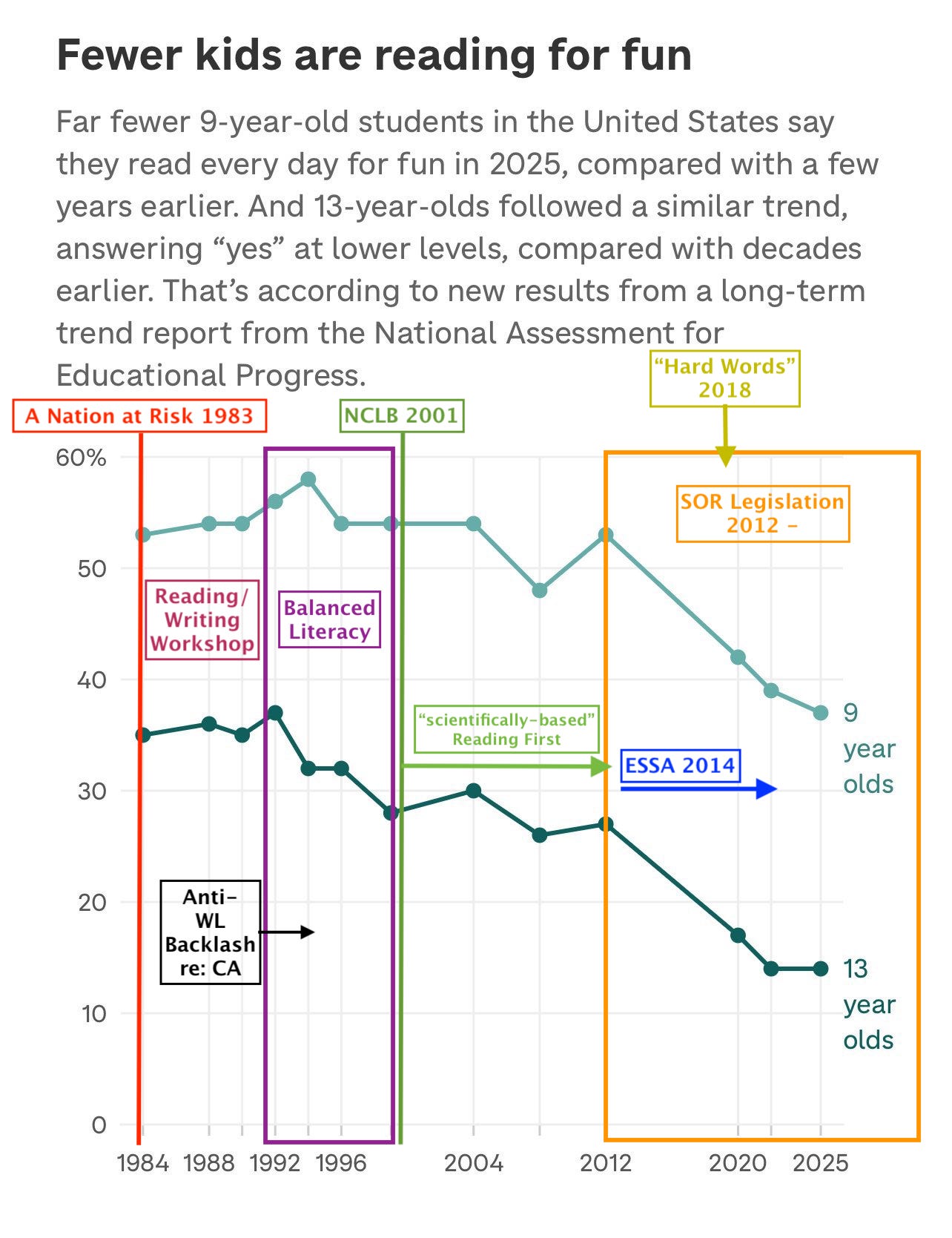
Today, Trevor Bryan, art teacher and scholar, reached out to me through Instagram about a recent post of mine on NAEP Long-Term Trend data showing a drop in students reading for fun:
Hey Paul, read your post on the recent NAEP trends and in looking at the breakdown of the “eras” of instruction, what do you thing contributed to relatively sudden gains in reading in the early 90s and then the drops just a couple of years later during the balanced literacy era?
This prompted me to revisit the chart and update (see the beginning of the post).
I added two important eras: The reading/writing workshop era that was grounded in the National Writing Project and important books by Nancy Atwell (reading workshop) and Lucy Calkins (writing workshop), and the anti-whole language backlash grounded in a national moral panic about test score declines in California.
Key here is that workshop appears to correlate with increases in reading for fun while the decline in reading for fun correlates with the outsized (and false [1]) anti-WL backlash.
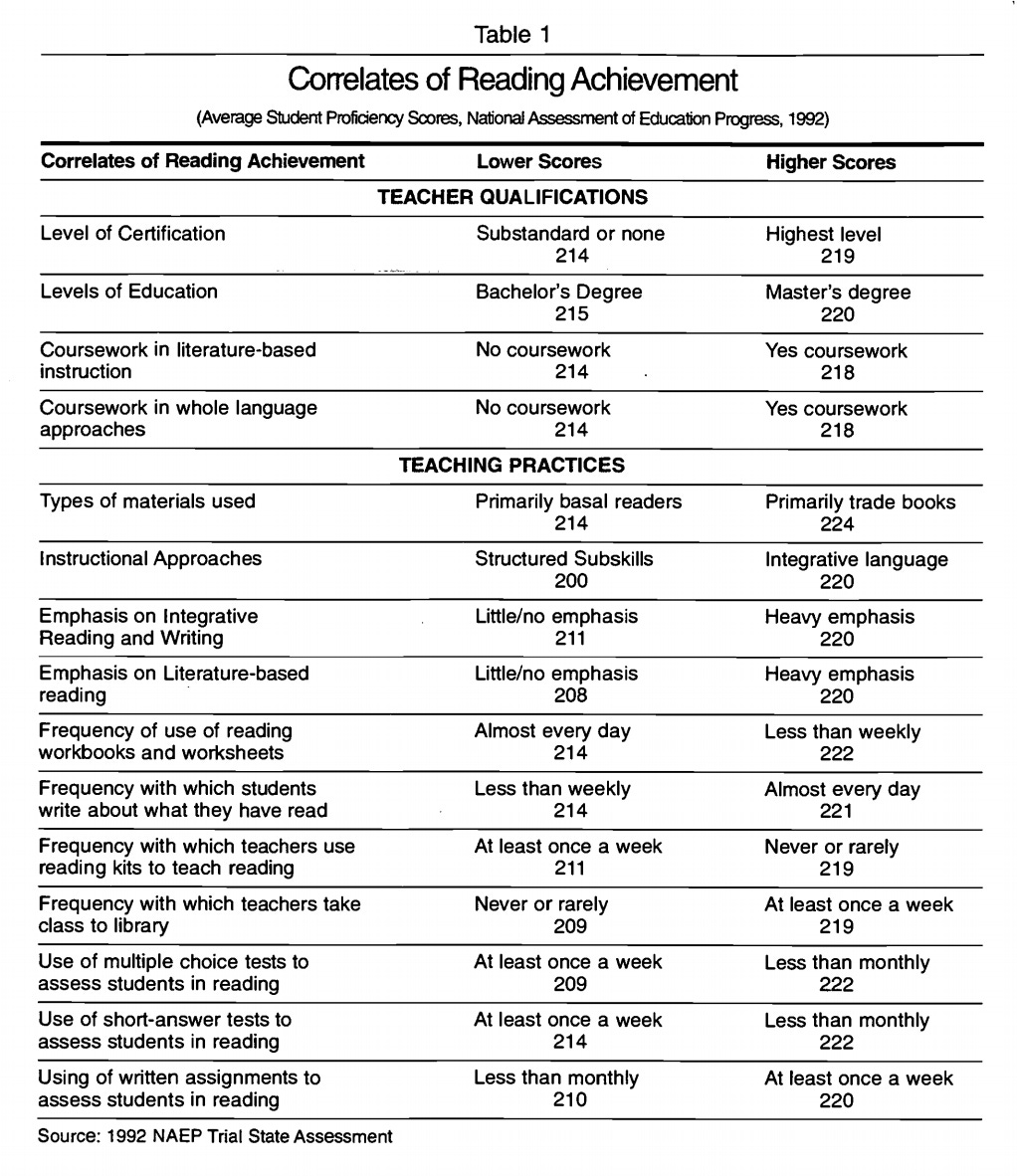
One frustrating aspect of that late 1980s-early 1990s anti-WL backlash was that most people ignored that Linda Darling Hammond found a positive correlation between whole language/workshoip and higher NAEP scores based on 1992 NAEP scores:
Regretfully, much of the media, political, and public debates about reading (and writing) are petty—corrupted by market interests, ideology, and non-expert beliefs about literacy.
There is, none the less, a great deal of evidence that reading and writing, as holistic human behaviors that must be learned, are best supported by holistic instructional approaches that balance the skills of literacy with authentic (real books and real writing done by choice) and whole experiences with texts.
Holistic advocates are often falsely attacked as being against direct instruction or negligent about skills (they aren’t); but skills advocates do openly challenge students engaging with whole texts (phonics first arguments are common) and trivialize the need for joy and pleasure in reading.
Many credible criticisms have been raised about misusing or misunderstanding the workshop method (I recommend Lou LaBrant and Lisa Delpit), but this is not about the effectiveness of workshop as a structure for fostering literacy, especially a literacy that is not only proficient but filled with wonder, joy, and eagerness.
A few years ago, when I wrote about the moral panic around AI and writing in school, I revisited a chapter I wrote about writing in a de-grading/de-testing book I co-edited.
Since I taught K-12 schooling from 1984-2002, I declared that the high-stakes accountability era prompted by A Nation at Risk under Reagan effectively and eventually killed all the promises offered for reading and writing by the NWP and workshop instruction.
In 2013, Applebee and Langer essentially confirmed that argument in a major study of writing that showed students were writing less and only briefly when they did write because of the demands of standards and testing.
Instruction in the US has been standards-and-test focused for forty years, and holistic, authentic experiences with reading and writing for students has been eroded by accountability mandates and then even more directly attacked under the current “science of reading” era in which whole-class, teacher-centered skills instruction for all students is now not just a trend, but legislated.
I started this post with my journey to being not just highly literate but someone whose life is significantly dedicated to reading and writing by choice—daily.
This is part of my life’s joy.
But I tell that story not to suggest this is the way everyone should become eager and skilled readers and writers, but to emphasize (as the opening chart does) that the journey to literacy is complicated—and defies attempts at scripts and mandates.
In fact, scripts and mandates are doing far more harm than good.
Let me end then with Trevor’s full comment clipped in the subheading above:
It’s funny, as an art teacher, I feel like the workshop model is the closest thing to a studio, which as curious, exploratory, creative beings, drives engagement which could lead to better discussions, sharing ideas and investment in writing responses which leads to better outcomes. Reading/writing is a creative act and as creative beings, the workshop model works.
Reading and writing are creative human acts that must not be reduced to compliance, as LaBrant argued: “On the other hand, we should not, under the guise of developing literary standards, merely pass along adult weariness” (pp. 275-276).
[1] See Whole Language and the Great Plummet of 1987-92: An Urban Legend from California by Stephen Krashen
If you want to help with the costs of keeping my public work open access and free, please DONATE.