Prelude: Looking for Lou LaBrant
From 1995 until 1998, I was in a wonderful doctoral program at the University of South Carolina (USC); however, I was simultaneously teaching full-time at Woodruff High School—a solid 90-minute drive from the USC campus—as well as adjuncting at Converse College.
My mind was expanding, almost with glee, while I was foolishly overextending myself in ways that would haunt me just a year after graduating.
None the less, this was my entry point into becoming a scholar as it also helped boost my career as a writer that had begun in the spring my first year of college, writing poetry inspired by e. e. cummings.
Attaining a doctorate was pivotal, but the most significant aspects of the program were members of my doctoral committee, notably the chair, Lorin Anderson, and Craig Kridel, who directed the Museum of Education as one of, if not the, leading scholar in educational biography.
My dissertation was an educational biography of Lou LaBrant, who had donated her papers, a small donation, along with writing her memoir for the Museum. That dissertation led to one of my first scholarly books, a revised version of my dissertation on LaBrant, but it also built the foundation of the next phase of my career when I moved to higher education in 2002.
Lou LaBrant lived to be 102 (although much of her life she identified her age 10 years younger than she was); at the end of her life, she wrote her memoir on a typewriter, completing it when she was 100.
I return to LaBrant often. I am still looking for her.
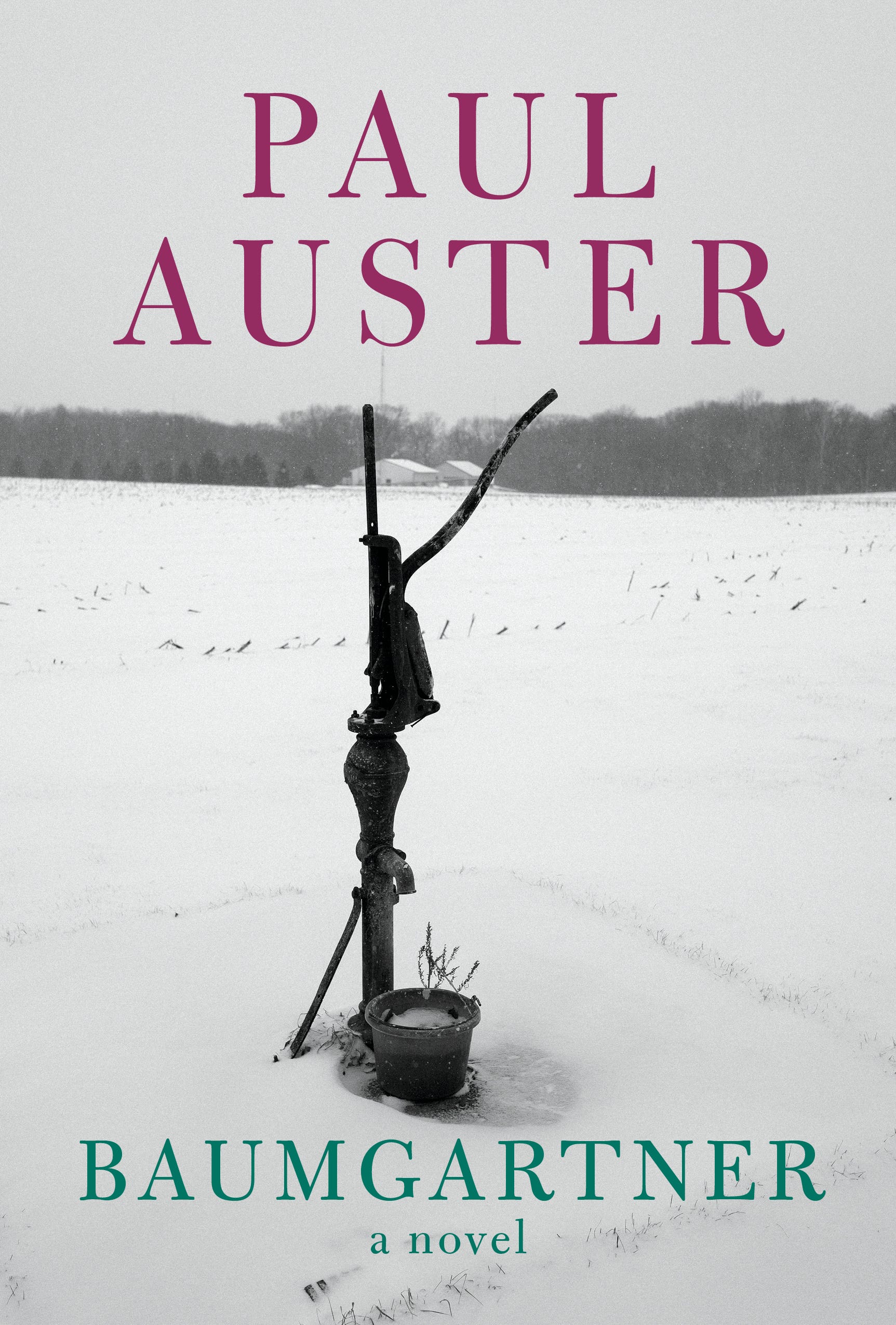
While reading Baumgartner by Paul Auster, I recalled a moment when I was reading LaBrant’s memoir as she lamented losing everyone she loved over her very long life. While reading, I saw a tear drop splash on the page, and it was then that I came to love the person I was trying to reanimate through biiography.
LaBrant catalogued her most difficult loses—her sister Roberta, her brother Wagner, and her love, Paul Witty, over whom she chose her career—admitting: “Being nearly ninety-seven is a lonely age.”
She also quoted a few lines from Rabbi Ben Ezra by Robert Browning:
Grow old along with me!
The best is yet to be,
The last of life, for which the first was made
And then: “Being old just means being left—a remainder. One merely says: I remember.”
Baumgartner: “His thoughts drift”
[Spoilers below]
Paul Auster opens and closes his novel Baumgartner with accidents, the first one prompting equal parts compassion and humor.
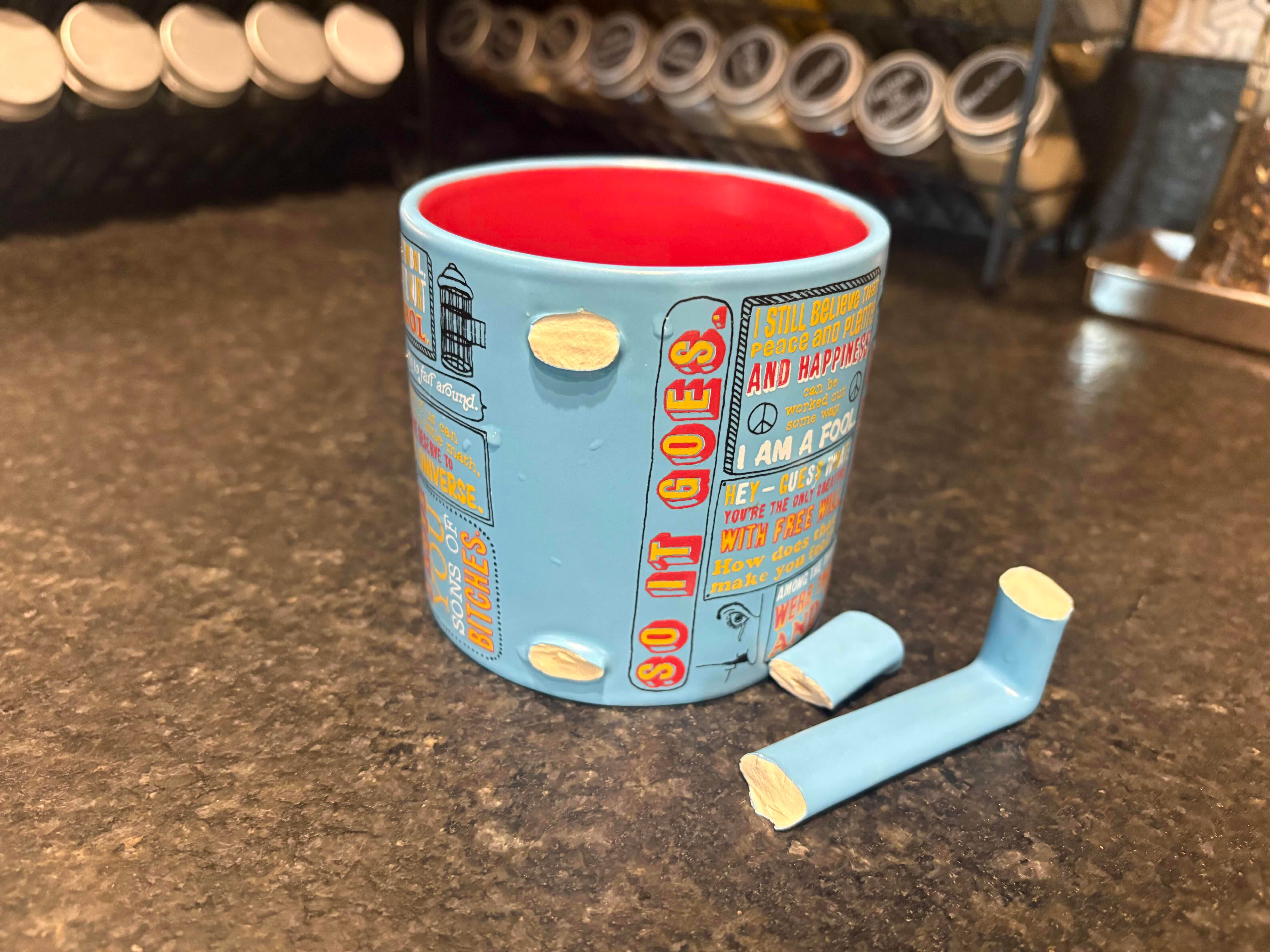
In the novel, Baumgartner is a professor and scholar who ages from about 70 to 72. As a fitting bit of irony, I am a 65-year-old professor and scholar who dropped his prized Kurt Vonnegut coffee mug while writing this (and intermittently doing our apartment Big Clean that I do on Tuesday), breaking the handle and throwing coffee everywhere, including on the novel I am writing about.
“So it goes.”
Much of this short and easy-to-read novel is about the inevitable decline that comes with aging and how that intersects with someone having lived, and living, the life of the mind.
I played the part of the doddering old man, and it wasn’t fun.
The Big Lie of literary fiction is the universality propaganda foisted upon society mostly by white men who see universality in the lives and living of white men.
Auster straddles that sort of literary fiction and his postmodern tendencies, and I deeply connected with much of the novel—although I am not suggesting here they are universal, just that they resonate with my lived experiences.
What I felt was a sort of deep-to-uncomfortable empathy because so much of the life created here matches my own.
The story of Baumgartner in his 70s parallels in ways the real life of LaBrant because he remains in a past that includes those he has lost and loved dearly.
In some ways, this is one of the saddest books I have ever read—although I often laughed out loud as well.
Baumgartner’s love for his deceased wife, Anna, is heartwarming, tender, and sad. He returns to her in many ways throughout the story.
But two aspects I want to highlight here are his remembrances of his father and his musing on being a writer.
On the latter, some of the highlights of the novel are pieces of writing by his wife and Baumgartner himself. Baumgartner’s essay, “The Wolves of Stanislav,” is a really wonderful piece of fictional non-fiction that opens:
Does an even have to be true in order to be accepted as true, or does belief in the truth of an event already make it true, even if the thing that supposedly happened did not happen?
Auster often delves into the meta of writing, and this essay (as well as the unbalanced narration) feels like Auster’s own musing (himself in his 70s) on the nature of how any writer portrays the truth, that tension that exists between fiction being created (some saying carelessly “not true”) and non-fiction often being labeled as “true.”
Immediately after the essay-in-the-narrative, Chapter 5, Baumgartner’s theory of writing is revealed, notably about once a book is finished in its first full draft:
Baumgartner refers to this post-composition period as the collapse, or Mrs. Doolittle in her cups, or, echoing the tagline of the old Coca-Cola ad from his childhood, the pause that refreshes.
There is a great deal of fretting also about having written a book he is proud of but fearing that it will not be accepted by the publishers. Here, I am reminded of my first subject for my dissertation (who I passed on before a friend wrote about him a few years later), William Van Til.
Van Til wrote often about being paralyzed with fear after completing a book and having it published, freed into the public sphere.
This conflicted nature of being a writer is well captured in Baumgartner.
But the part of the novel that buried itself in me was Baumgartner re-considering his father.
Baumgartner and Auster are a bit older than me, and Baumgartner’s father is generationally somewhere between my father and grandfathers.
As I have explored, my father and grandfathers (who bring to mind two words, “laconic” and “stoic”) were of generations where men steeled themselves against the world, emotions and affection absent or indirectly shared.
When Baumgartner is accepted to college, that moment is recalled:
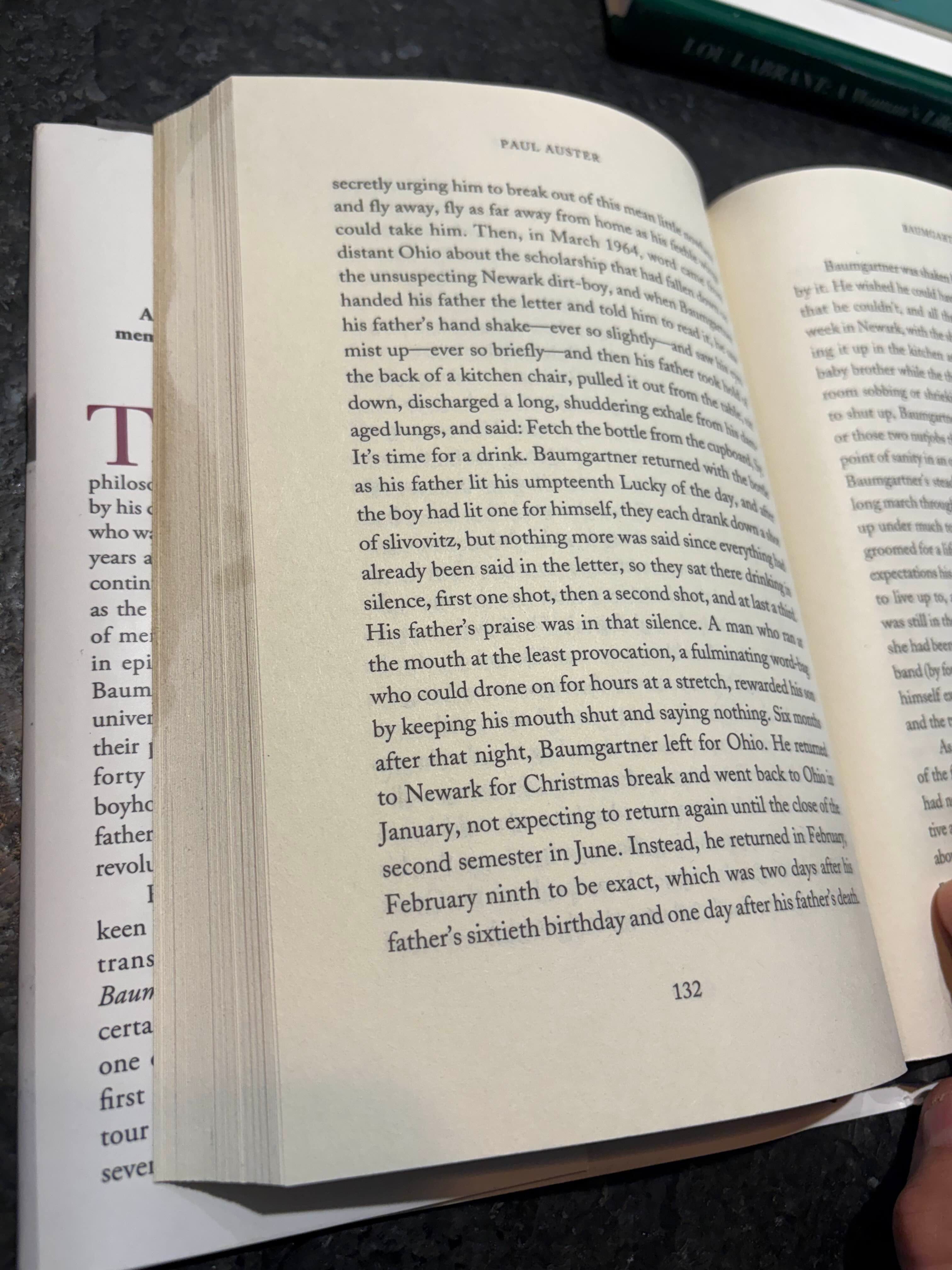
Fetch the bottle from the cupboard, Sy. It’s time for a drink. Baumgartner returned with the bottle as his father lit his umpteenth Lucky of the day., and after the boy had lit one for himself, they each drank down a shot of slivovitz, but nothing more was said since everything had already been said in the letter, so they sat there drinking in silence, first one shot, then a second shot, and at last a third. His father’s praise was in the silence. A man who ran at the mouth at the least provocation, a fulminating word-bag who could drone on for hours at a stretch, rewarded his son by keeping his mouth shut and saying nothing. (p. 132)
That contradictory description of his father makes me smile. My father talked relentlessly to people in public, from friends to acquaintances to total strangers (the latter much to my embarrassment). Then, little said to me other than reprimands and such until he was much older and began to say “I love you” every time we spoke.
Auster’s short novel is quirky, a roller coaster of tone and narrative perspective.
I cried and laughed. It drew me into the past, the people I have lost, and it hit on the raw nerve of awareness that when we are gifted with growing older, we also must accept the inevitable decline.
Like J. Alfred Prufrock’s struggles with aging—“I have measured out my life with coffee spoons”—Baumgartner confesses he once was bemused by older faculty who walked around with their fly undone—something that has begun to happen to him, and has become a measure of his own decline: “Now that it has started happening to him—four times in the past two weeks—he wonders how many months or years it will take before he becomes a full-fledged member of the club” (p. 109).
As a developing doddering old man, scholar, and writer, when I read that section, I checked my fly.
And so it goes.
See Also
Paul Auster Walks the Long Valley of Grief in a New Novel
If you want to help with the costs of keeping my public work open access and free, please DONATE.