Born in 1961, I am technically a Baby Boomer, although I fit into Generation Jones better I think.
That year of my birth a book was published, ominously titled Tomorrow’s Illiterates: The State of Reading Instruction Today. The edited volume has an Introduction by Jacques Barzun packed with moral panic and chapters cataloguing how children were not being taught to read—a lack of phonics being a key problem identified.
Chapter IV tells the story of an adult illiterate who graduated high school with honors! That chapter takes aim at whole-word reading instruction and guessing, in fact, for failing students.
Then in 1978, the year I was 17, when the picture above was taken of me as a graduating high school senior in 1979, the New York Times seemed to confirm the prediction from 1961: Illiteracy in the U.S.: Why John Can’t Cope (H/T Ralph Pantozzi).
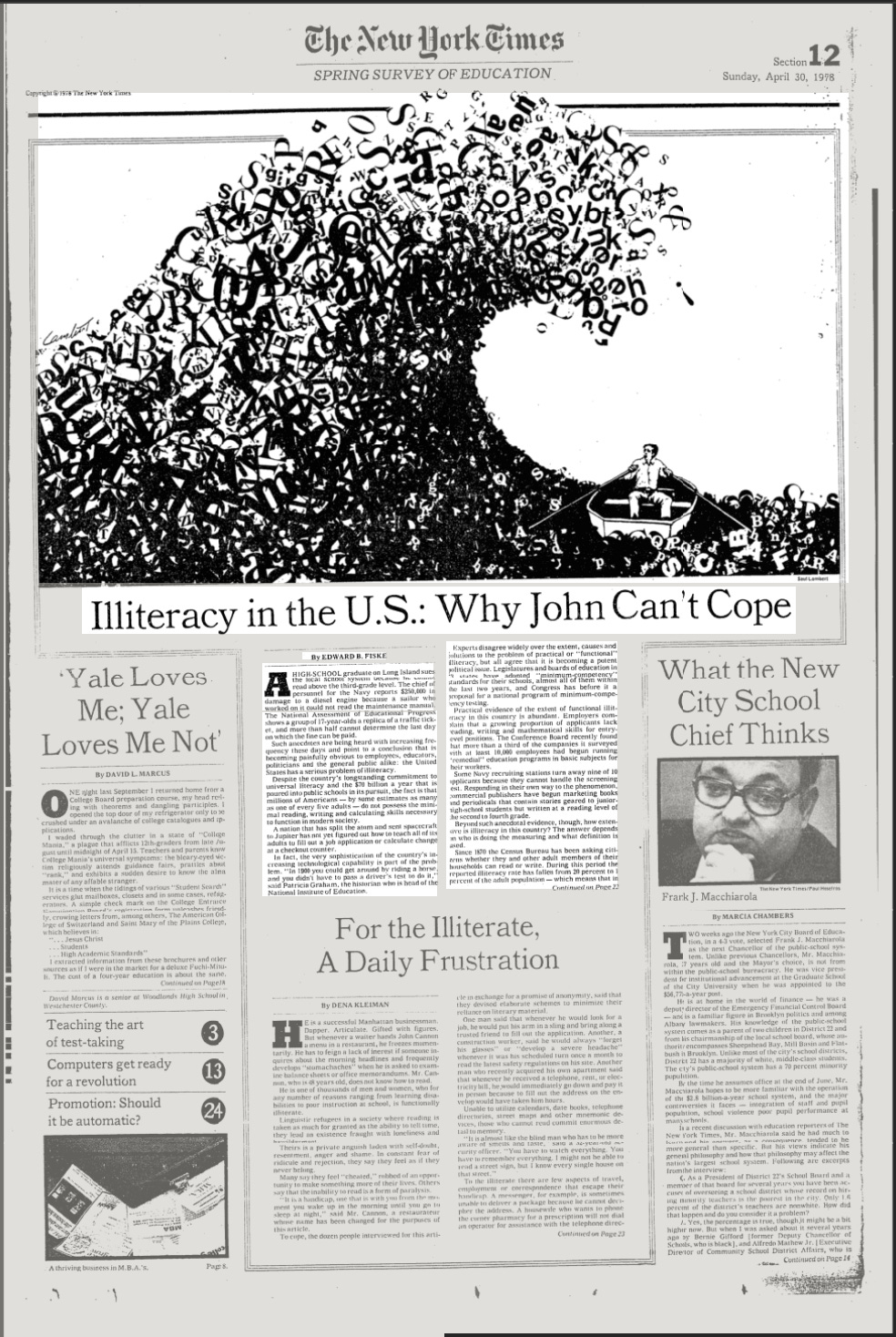
Below that article by Edward B. Fiske sits another piece featuring an adult illiterate, paralleling the chapter from 1961.
Fiske opens with some compelling stories:
A high‐school graduate on Long Island sues the local school system because he cannot read above the third‐grade level. The chief of personnel for the Navy reports $250,000 damage to a diesel engine because a sailor who worked on it could not read the maintenance manual.
The National Assessment of Educational Progress shows a group of 17-year-olds a replica of a traffic ticket, and more than half cannot determine the last day on which the fine can be paid.
Such anecdotes are being heard with increasing frequency these days and point to a conclusion that becoming painfully obvious to employees, educators, politicians and the general public alike: the United States has a serious problem of illiteracy.
Despite the country’s longstanding commitment universal literacy and the $70 billion a year that poured into public schools in its pursuit, the fact is that millions of Americans — by some estimates as many as one of every five adults — do not possess the minimal reading, writing and calculating skills necessary to function in modern society.
O, if only Emily Hanford had been there to turn these anecdotes into a podcast and save us!
Well, maybe not.
You see, this sort of moral panic over “kids today” and reading in 1978 was about my generation (Boomers) as those “kids today,” and the entire NYT piece reads just like current journalism and podcasts lamenting “kids today” as illiterate.
Fiske details more anecdotes from employers and the Navy lamenting the need for remedial courses for workers and naval recruits as well as “commercial publishers have begun marketing books and periodicals that contain stories geared to junior high‐school students but written at a reading level of the second to fourth grade.”
Notably, NAEP is featured prominently in the piece:
The federally financed National Assessment of Educational Progress, which has conducted similar surveys of schoolchildren, estimated that 13 percent of 17-year-olds still in school could be classified as functionally illiterate. For a substantial minority of the adult population, said Roy H. Forbes, director of the National Assessment, “society's attempts at providing equal educational opportunities apparently have not yet resulted in equal educational benefits.”
The list of blame includes TV, the rise of oral culture (alas, letter writing had been replaced by the phone call!), and of course the lax expectations of teachers and administrators in US schools (this final blame from Admiral Hyman G. Rickover who made a career of fomenting educational crisis for decades starting in the late 1950s along with sounding the alarm over how Swiss schools outperformed US schools).
The article has a section later on the current state of early literacy education that seems to contradict the articles larger concern, including some good news from NAEP:
There is evidence that — at least at the lower grades — American schools are doing this with considerable success. For the last several years the National Assessment has been reporting gains in the reading level of 9-year-olds, and figures on reading tests administered last spring to New York City public elementary‐school pupils showed that students in the first two grades were reading slightly above the national average.
There are good reasons why children today are performing better than ever in the early school years. The Federal Government has poured millions of dollars into schools in disadvantaged areas through the Title I and other programs, most of which has gone into the early grades, and this now seems to be paying off. Furthermore, much more is known about how to teach basic reading.
At the beginning, learning to read essentially a process of learning the written symbols for sounds, words and phrases that a child already knows through hearing. In the process known as “decoding,” the child learns that the letters DOG stand for the family pet. Research has led to virtually sure‐fire methods of teaching this basic skill, and it can even be argued that at this point television is an aid to learning reading because it builds up a child’s oral vocabulary. (Third‐graders who have learned their lessons well would thus probably be considered fully literate by the standards of 17th‐century New England: able to sound out familiar material).
Beginning with the upper elementary grades, though, the task changes to one of building up comprehension. The student must begin to work with words he or she does not already know by ear. In- stead of “learning to read” the student must begin “reading to learn.” This is considerably more complicated, both for the student and the teacher, and it is evident from the drop off that occurs beginning with the fourth grade in scores on standardized reading tests not just in big cities like New York but across the board — that at this level the schools are not succeeding.
In educational terms, the literacy problem — at least as it refers to reading — may be redefined as the problem of how to move students from the mastery of “decoding” to the eight‐grade level generally associated with “functional literacy.”
How to do this, of course, is the subject of wide disagreement. Some say that more research is needed on the nature of the learning process at the upper elementary level, and concern over academic standards at all levels has turned the so‐called “back-to-basics” movement into one of the most powerful forces in American education.
On a broad front, “back to basics” is forcing schools to concentrate on core academic subjects such as reading, mathematics, writing and the sciences, and there is some evidence that it is having a positive effect. A recent study of high schools that had resisted the national trend toward declining Scholastic Aptitude Test scores found that one common characteristic was insistence that students complete a “core” of academic courses before taking electives.
Oddly, beginning readers needed only to decode in the 1970s with comprehension a thing for grade 8. (Just as a side note, the whole learning-to-read/reading-to-learn dichotomy has long been rejected in the field of reading.)
Also, back in 1961, Walcutt declared: “We have said that no further ‘research’ into methods of reading instruction is necessary” (p. 141).
And yet, by 1978, widespread teen illiteracy! However: “Research has led to virtually sure‐fire methods of teaching this basic skill.”
There is a pattern, you see: Crisis, lack of phonics, illiteracy, but don’t fret, we know how to teach the basics if only those incompetent teachers would do it!
And then, buried at the end:
Some observers also note that while the back-to-basics and minimum competency movements may be steps in the right direction, the changes are aimed at schools, which are neither the entire cause nor the entire solution to the problem of illiteracy.
A report prepared by World Education, a nonprofit research organization, for the Ford Foundation, declares: “The functionally illiterate persons in this country are the same persons, in general terms, who suffer from any of the other major social disadvantages —poverty, unemployment, racial or ethnic discrimination, social isolation. Inadequate education will probably be only one manifestation of their deprivation.”
First, I am not sure how I survived being a part of an illiterate generation, becoming ironically a highly literate person whose career depends on an advanced level of literacy.
And finally, this article from 1978 is yet another example of how the more things change, the more they stay the same.
You must realize the 1940s and 1950s were also eras of reading crisis, yet somehow, the Boomer generation, a generation of illiterates, are often viewed as one of the most productive generations in US history. Go figure.
Thus, we need a new story, folks.
If you want to help with the costs of keeping my public work open access and free, please DONATE.