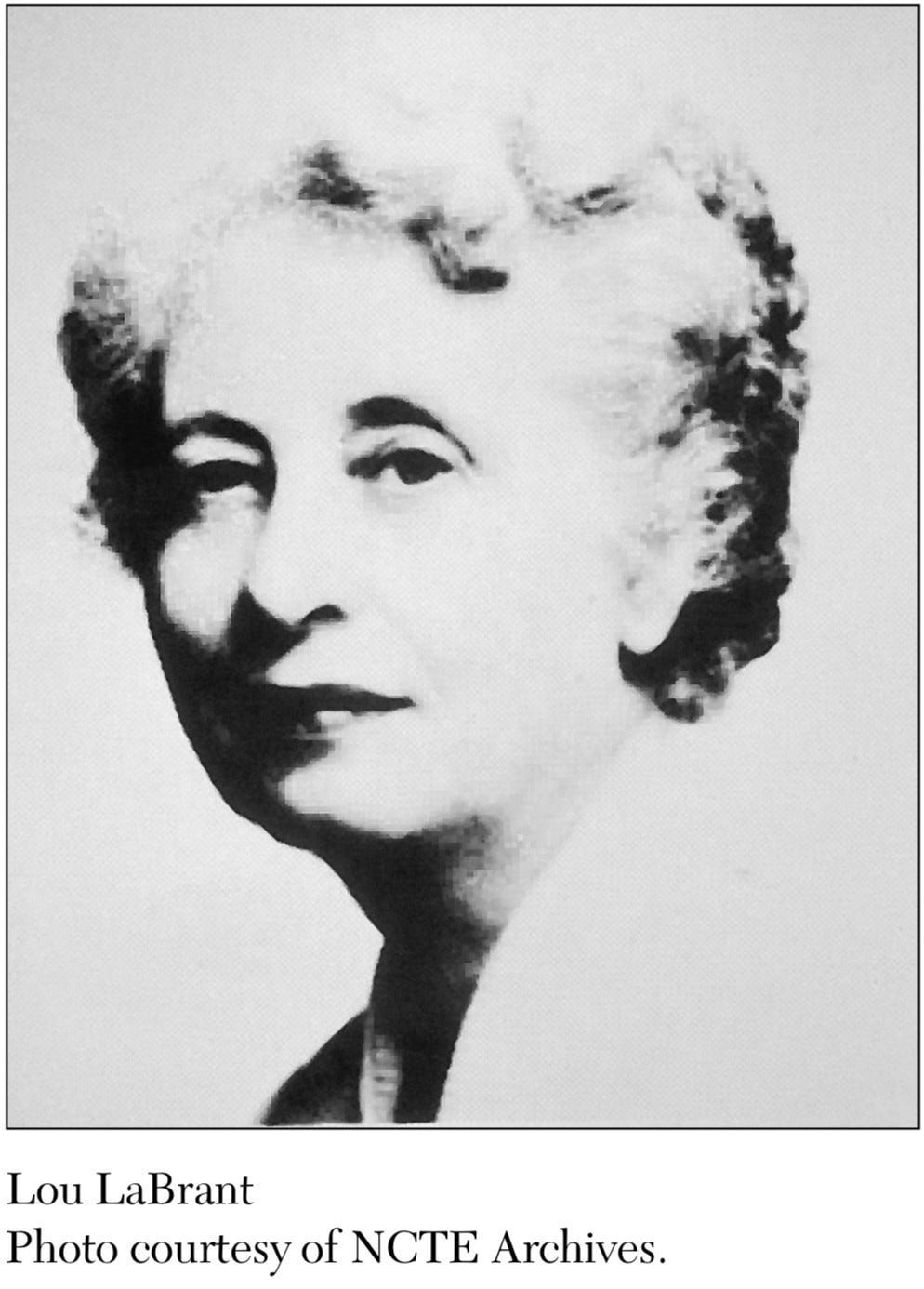
Lou LaBrant: Understanding Reading Today through the Lens of the Past
"In Russia today we see the horrible spectacle of young persons taught one and only one theory, limited in their reading experience to the book which fosters the national code of beliefs." (1951)

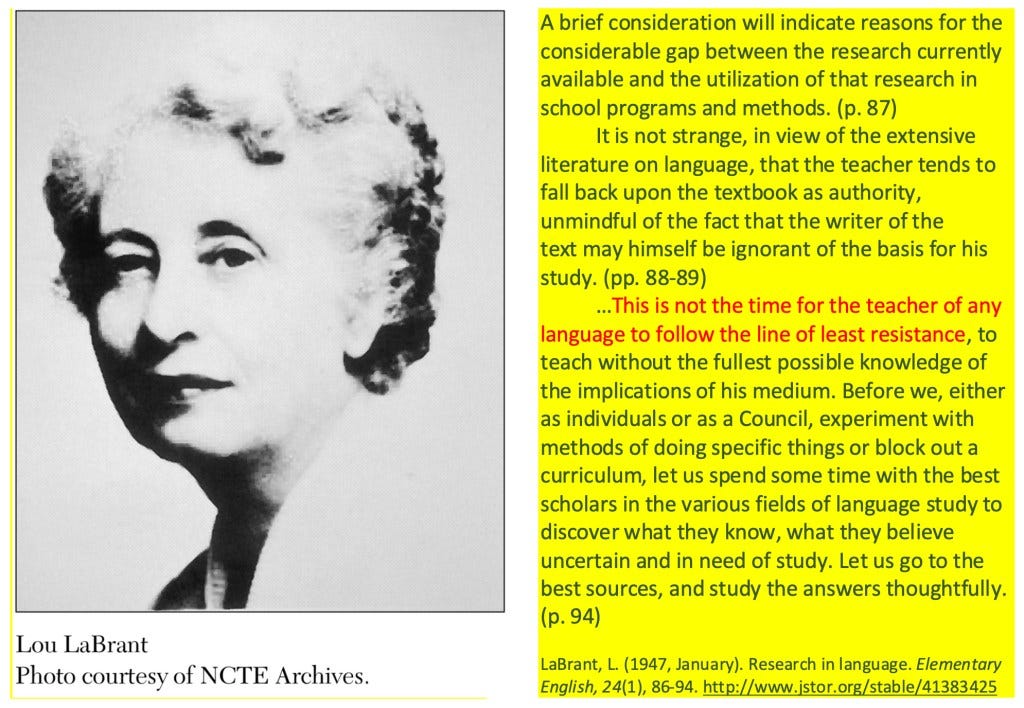
This is not the time for the teacher of any language to follow the line of least resistance, to teach without the fullest possible knowledge of the implications of his medium.
LaBrant, L. (1947, January). Research in language. Elementary English, 24(1), 86-94. http://www.jstor.org/stable/41383425
I entered my doctoral program committed to writing an educational biography under the guidance of Craig Kridel at the University of South Carolina, where he maintained the Museum of Education that housed a treasure of educator’s documents, photographs, and other material.
My naive initial choice for a subject was the writer John Gardner, who was also well regarded as a teacher of writing; however, Craig had already targeted me to write about educator William Van Til, whose papers were donated to the museum.
In maybe the first course I had with Craig, another student was assigned Lou LaBrant while I had Van Til.
A turning point in my career as a scholar occurred when that doctoral candidate gave a presentation on LaBrant that included the apocryphal from LaBrant’s memoir, written at the age of 100 for the museum.
LaBrant claimed that as a student, one of her teachers declared that even Jesus used proper English, sharing as proof “It is I” from the King James bible with the students. In classic LaBrant style, she added that even as a chiild she knew this prescriptive and authoritarian approach to language was foolishness (and LaBrant was widely known throughout her life to suffer no fools).
I was hooked and asked Craig to switch to LaBrant (several years later, a friend and colleague, Ed Welchel, wrote an educational biography of Van Til).
LaBrant’s career as an educator and literacy scholar is massive—teaching from 1906 until 1971 and remaining active until her death at age 102. I have created and maintained an online annotated bibliography of her work, including publications from 1922 until 1988.
Once I began reading and studying LaBrant’s memoir, which she typed herself despite fading eyesight, I realized that her career was not just the history of literacy in the US but the history of literacy debates.
Writing about the Reagan years, LaBrant railed against yet another back-to-basics movement, having worked through at least three or four back-to-basics/reading crisis cycles since she began teaching in 1906.
LaBrant was a Dewey progressive who rejected reading programs as well as education fads, such as the project method:
The cause for my wrath is not new or single. It is of slow growth and has many characteristics. It is known to many as a variation of the project method; to me, as the soap performance. With the project, neatly defined by theorizing educators as “a purposeful activity carried to a successful conclusion,” I know better than to be at war. With what passes for purposeful activity and is unfortunately carried to a conclusion because it will kill time, I have much to complain. To be, for a moment, coherent: I am disturbed by the practice, much more common than our publications would indicate, of using the carving of little toy boats and castles, the dressing of quaint dolls, the pasting of advertising pictures, and the manipulation of clay and soap as the teaching of English literature. (p. 245)
Wrath was a constant companion for LaBrant, who often bristled at moral panics over reading, abruptly challenged classroom teachers, and sparred with colleagues with a matter-of-fact fervor that was disarming.
In the context of the moral panic in the US that students today cannot and do not read (often because of the incompetence of teachers and teacher educators, the story goes), LaBrant’s career and publications offer a historical lens showing that there really is nothing new when it comes to the reading crisis/war cycle currently being labeled the “science of reading.”
LaBrant was a powerful advocate for teacher professionalism, student-centered pedagogy, student choice, and holistic understanding of literacy. And she was a resolute champion for personal and intellectual freedom, shaped significantly by WWII.
…Adolph Hitler voiced and promoted a horrible doctrine: that a man or nation was justified, to serve selfish ends, in using language to confuse rather than inform; that the big lie, repeated, could destroy the effectiveness of truth even with those who recognized the lie, and that this kind of behavior could be justified. Russia has frequently adopted such action. Unfortunately some Americans have also, although as a nation we have abhorred this doctrine….
LaBrant, L. (1951, April). English at the mid-century. RHO Journal, 28-31.
What is notable, however, is LaBrant embodied high-standards for students and teachers that defies historical and current claims that progressives somehow embrace a soft or passive approach to teaching and learning.
I often assign LaBrant (and Louise Rosenblatt, who died at 99, was a colleague of LaBrant’s at NYU, and spoke at length with me while I was working on my dissertation) in my graduate literacy course; students are often stunned at the current relevance of these works, and that the arguments simply haven’t changes over the past century.
LaBrant is often quotable (see some memes created from her publications), and anyone interested in the history or literacy can and should spend hours among her publications (annotated at my site with links to JSTOR when available).
In Russia today we see the horrible spectacle of young persons taught one and only one theory, limited in their reading experience to the book which fosters the national code of beliefs. (p. 136)
…Such an approach will not begin by telling the student what to believe. A first step is to discover his own emphasis, his interpretation….We do not do this, I think, by didactic statements about what to believe, or by presenting a uniform picture of what is the good. (p. 137)
LaBrant, L. (1951, March). Diversifying the matter. English Journal, 40(3), 134–139. https://www.jstor.org/stable/807316
Below are select passages from some of her works that relate to the current over-sold and misleading “science of reading” movement:
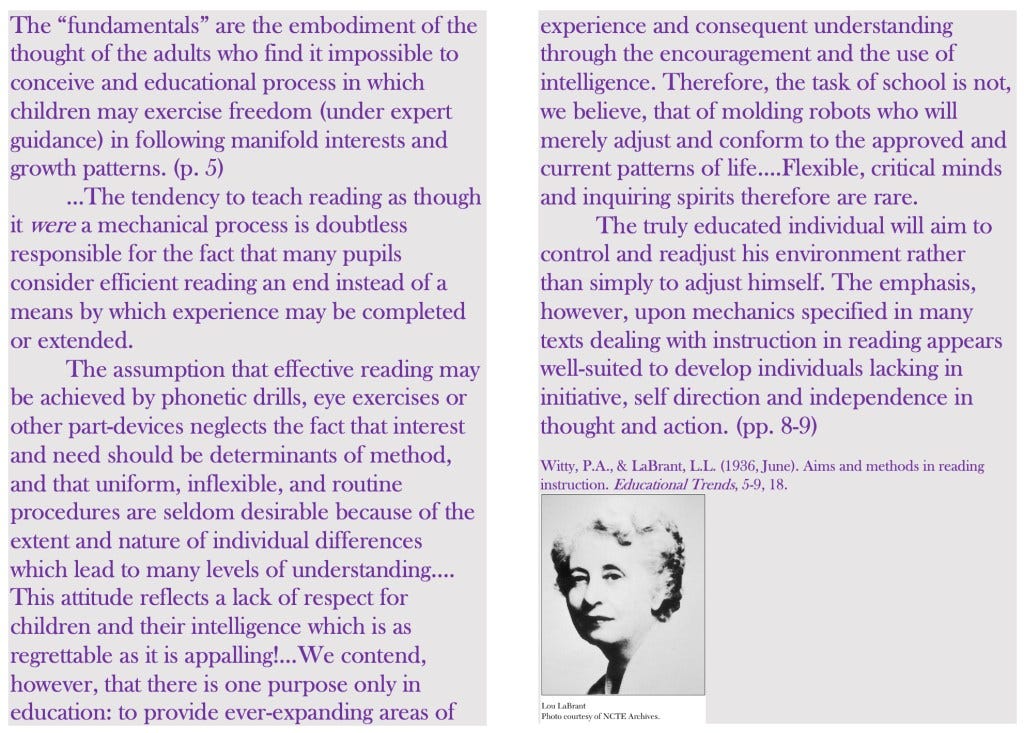
Witty, P.A., & LaBrant, L.L. (1936, June). Aims and methods in reading instruction. Educational Trends, 5-9, 18.
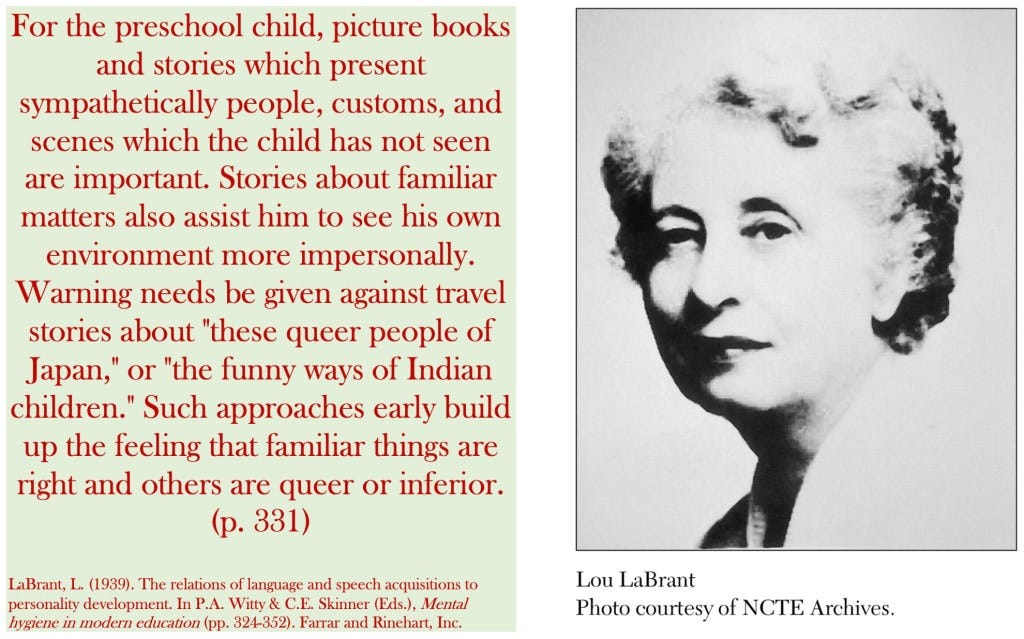
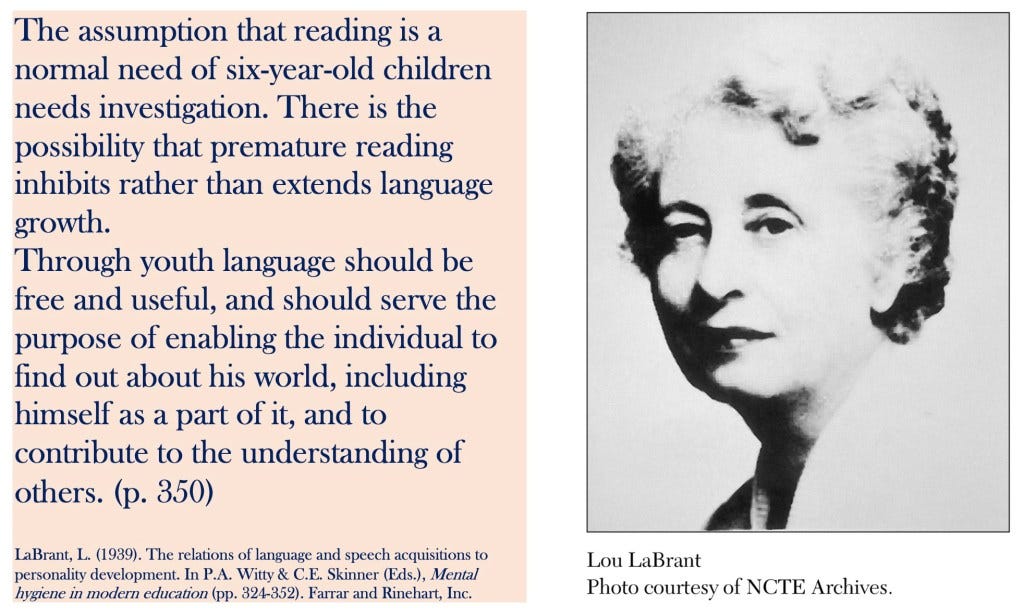
LaBrant, L. (1939). The relations of language and speech acquisitions to personality development. In P.A. Witty & C.E. Skinner (Eds.), Mental hygiene in modern education (pp. 324-352). Farrar and Rinehart, Inc.
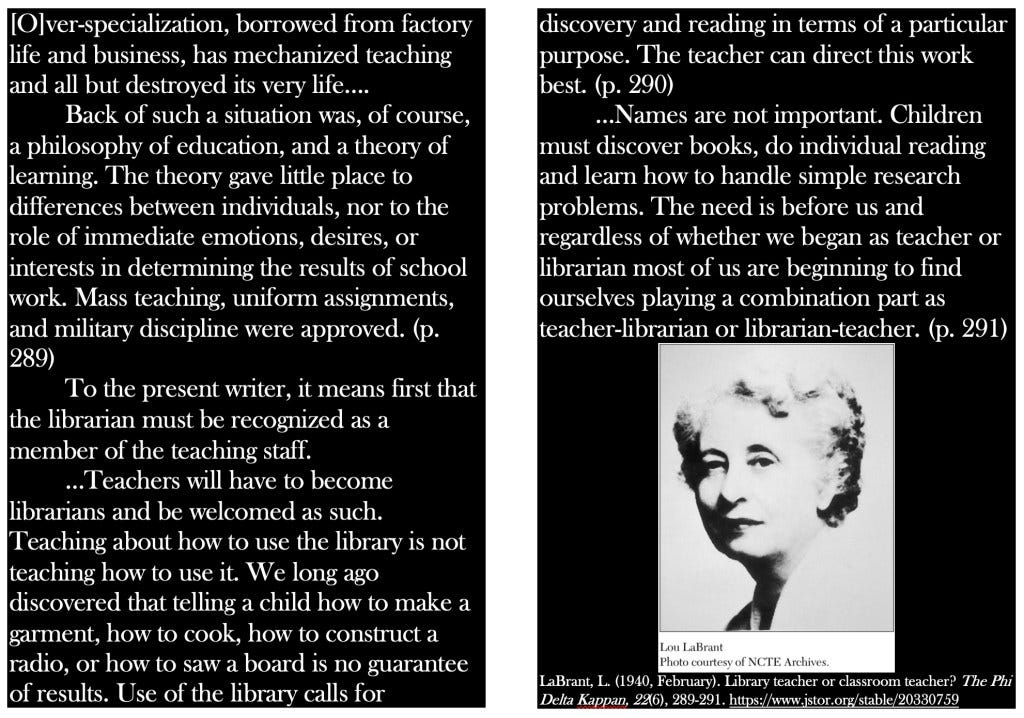
LaBrant, L. (1940, February). Library teacher or classroom teacher? The Phi Delta Kappan, 22(6), 289-291. https://www.jstor.org/stable/20330759
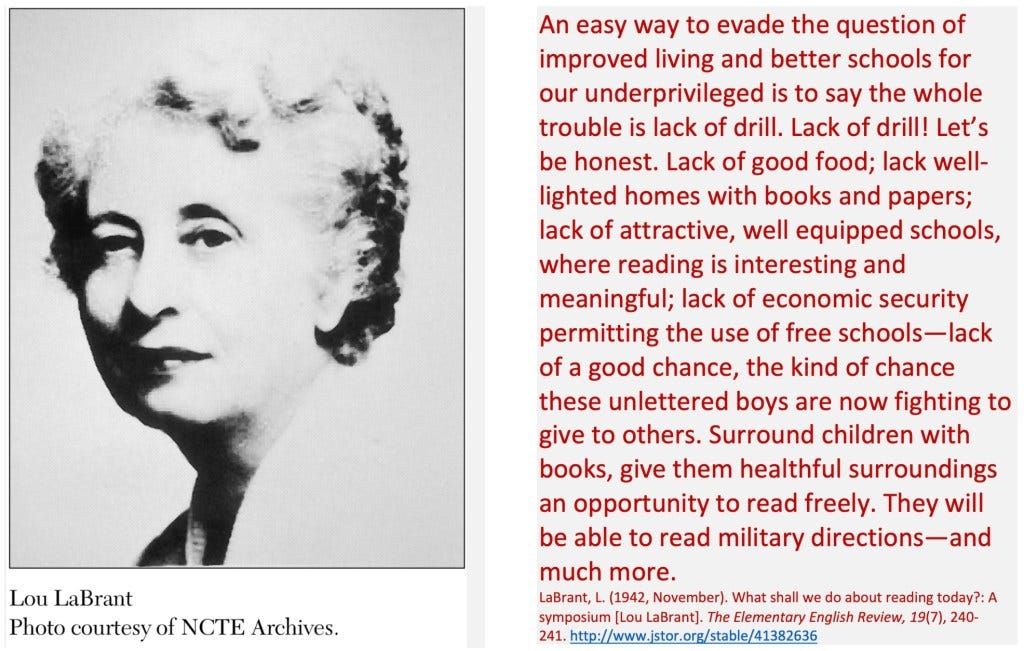
LaBrant, L. (1942, November). What shall we do about reading today?: A symposium [Lou LaBrant]. The Elementary English Review, 19(7), 240-241. http://www.jstor.org/stable/41382636
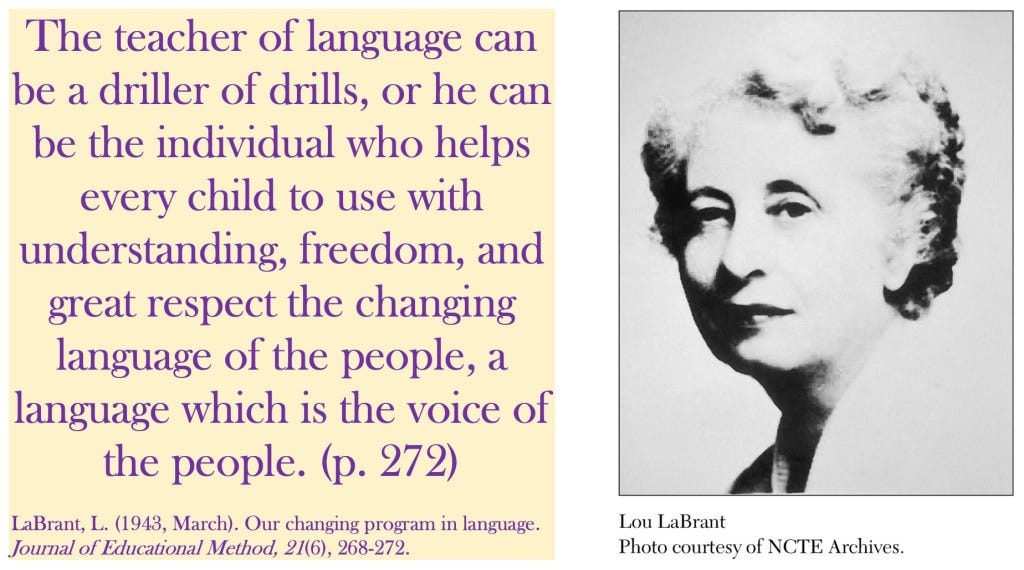
LaBrant, L. (1943, March). Our changing program in language. Journal of Educational Method, 21(6), 268-272.
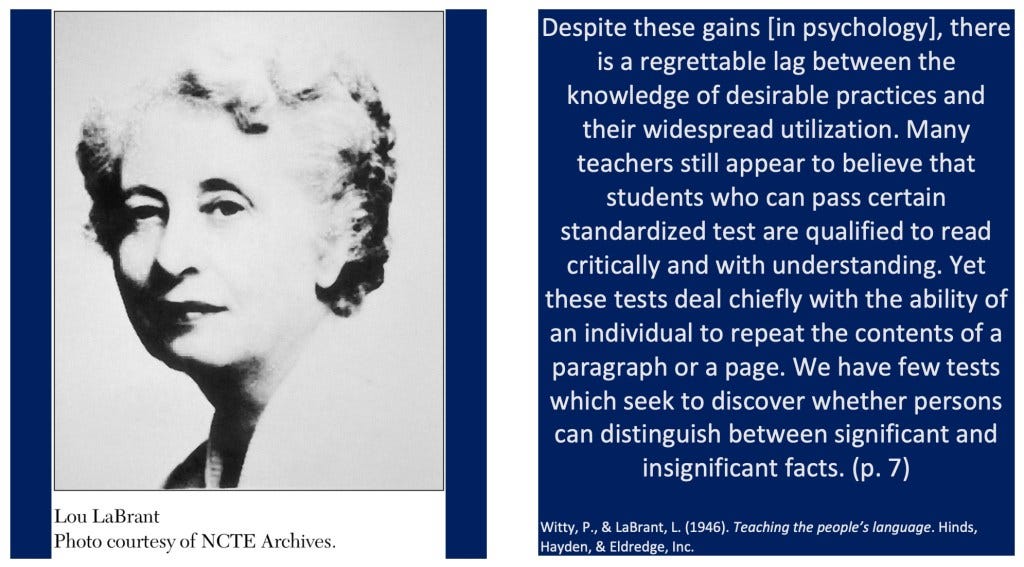
Witty, P., & LaBrant, L. (1946). Teaching the people’s language. Hinds, Hayden, & Eldredge, Inc.
LaBrant, L. (1947, January). Research in language. Elementary English, 24(1), 86-94. http://www.jstor.org/stable/41383425
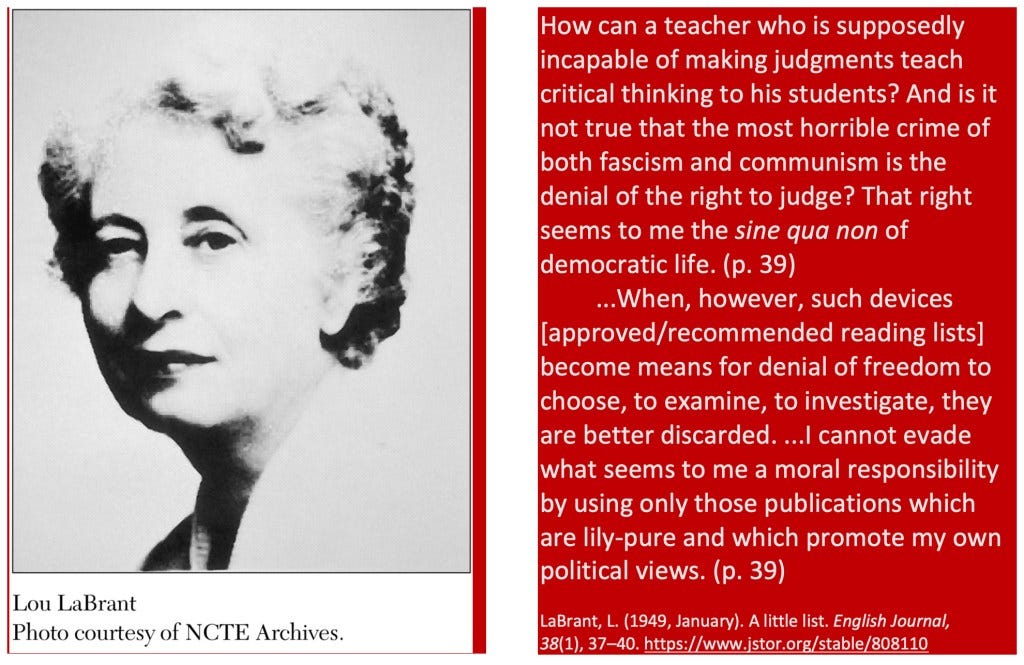
LaBrant, L. (1949, January). A little list. English Journal, 38(1), 37–40. https://www.jstor.org/stable/808110
If you want to help with the costs of keeping my public work open access and free, please DONATE.