The media, political leaders, and education reformers are making a mistake about reading reform well explained in the parable of the blind men and the elephant.
In this case, many are rushing to make over-stated claims about reading reform in Mississippi by hyper-focusing on limited and distorted data—grade 4 NAEP scores on reading.
First, research details that states implementing reading reform have achieved some short-term test score increases in grade 4; however, those gains disappear by grade 8. And more damning, the determining factor in successful reform is exclusively grade retention policies (not teacher training, reading programs, direct instruction, etc.).
Next, grade retention in Mississippi has been analyzed revealing that retention distorts those scores, resulting in a statistical manipulation of the data and not higher student achievement. In short:
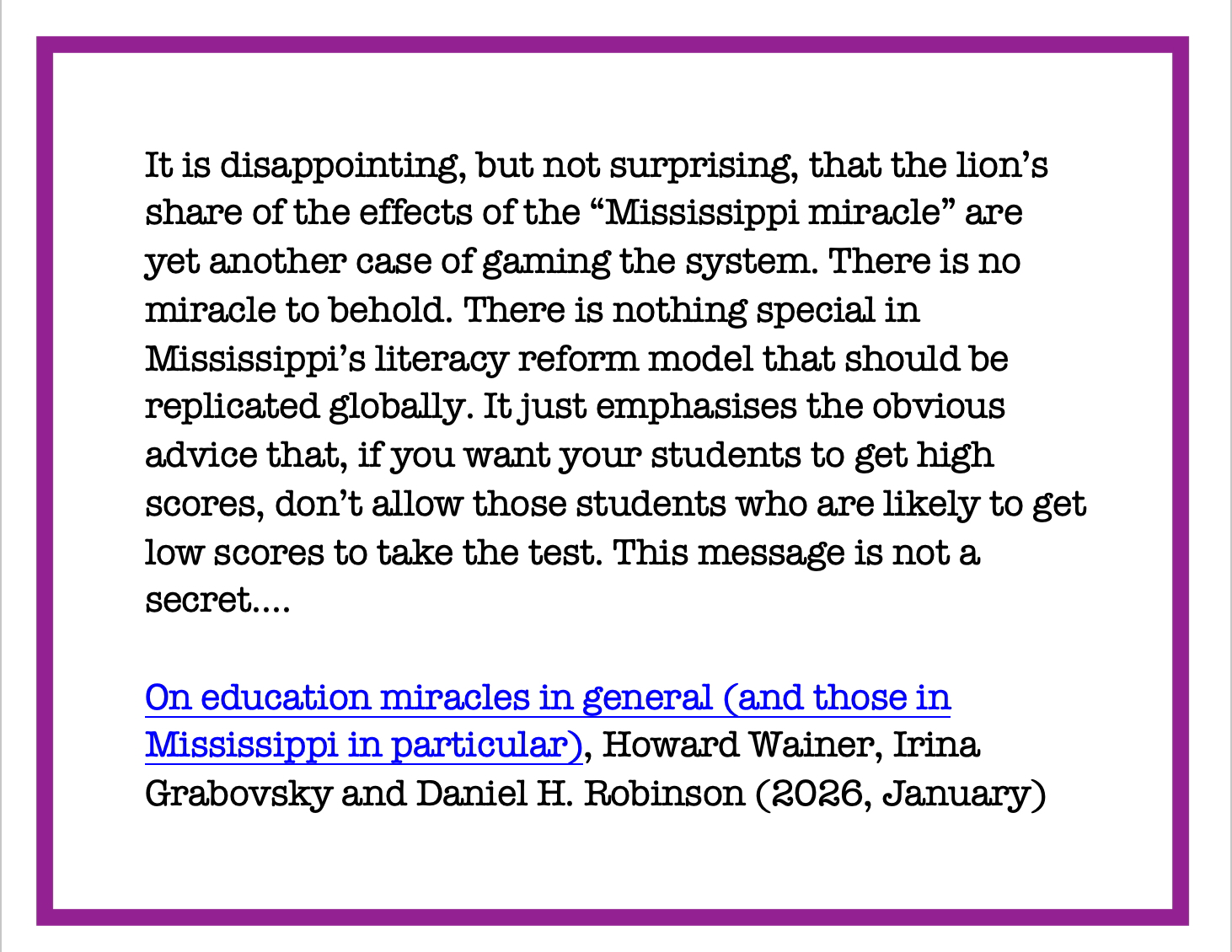
Yet, a new story has emerged claiming that Black students in MS are outperforming Black students in other states, notably California:

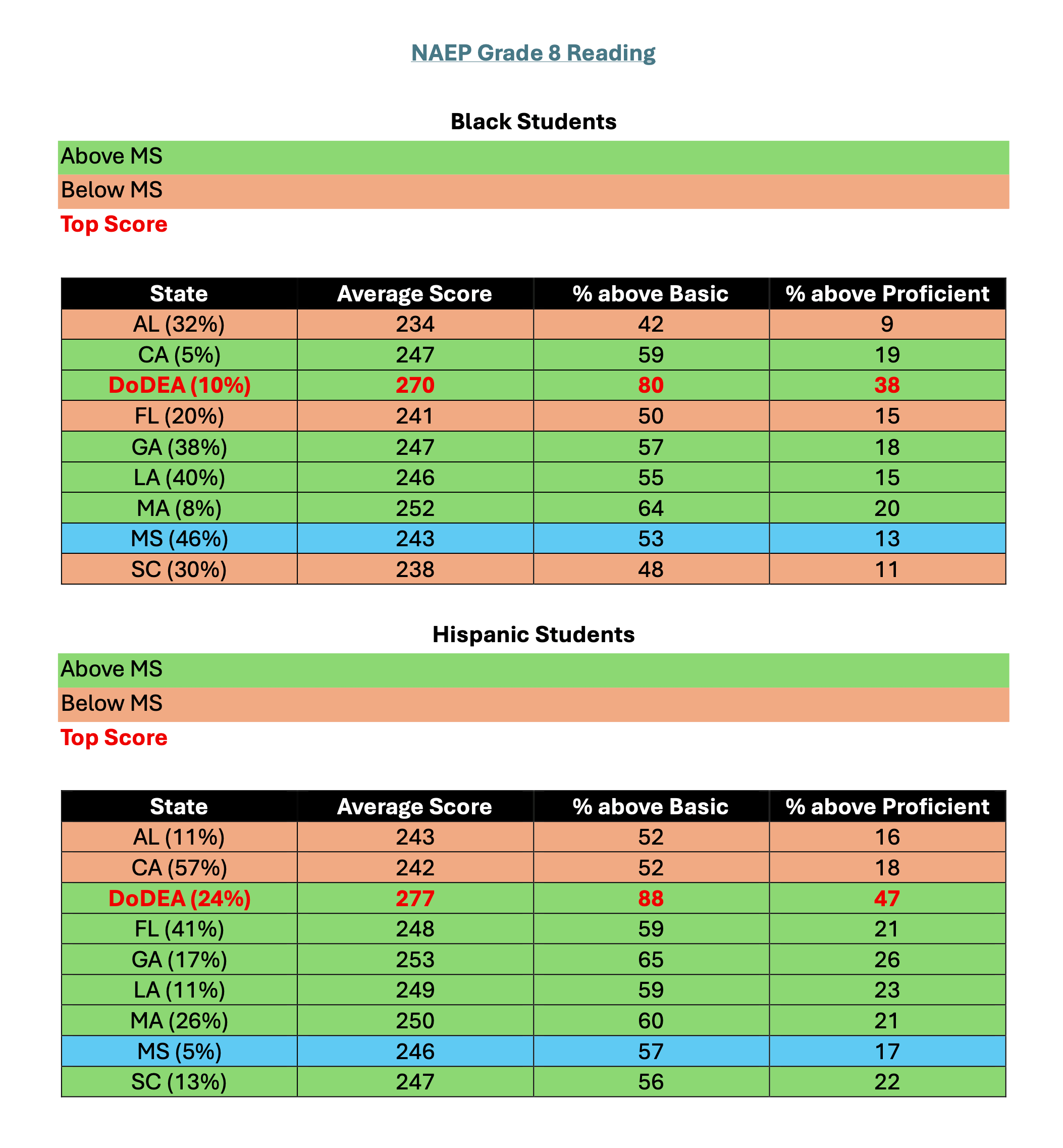
This sort of state comparison is grounded in political/ideological bickering that is challenged when grade 8 NAEP reading scores are analyzed instead of grade 4:
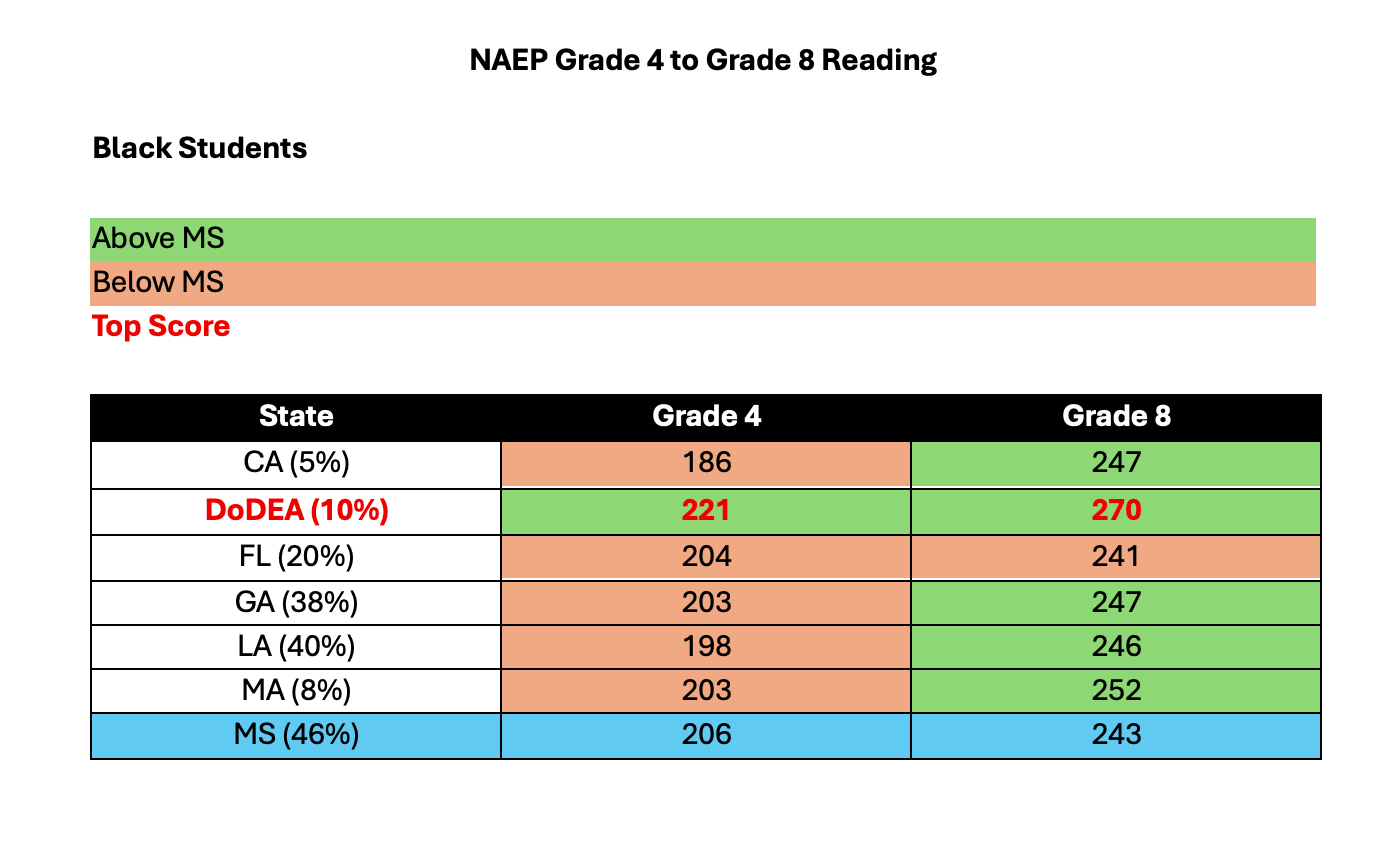
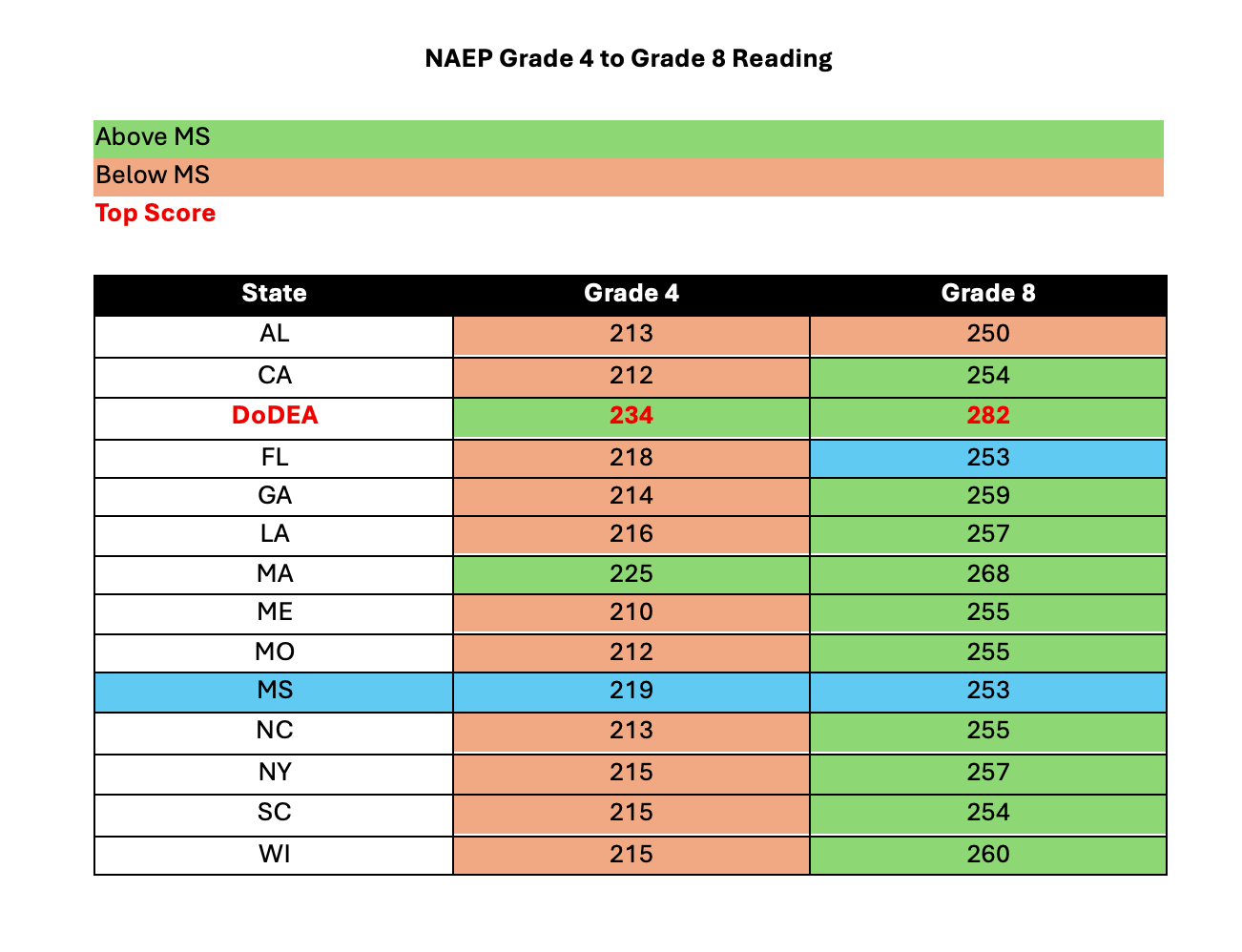
Also note the significant shift in comparisons between CA and high-retention states (FL, MS) from grade 4 to grade 8 reading scores on NAEP; as well, CA, GA, LA, and MA have Black student scoring lower than MS but higher by grade 8:
Suggesting that Black students are being better served in MS than CA is at least misleading. In fact, Black students in CA, GA, LA, MA, and notably the Department of Defense (DoDEA) schools outperform Black students in MS at grade 8.
Key here is that grade 8 NAEP scores are better data (see also this on Alabama) because of the distorting impact of grade retention (usually grade 3) on grade 4 data; note the number of states behind MS in grade 4 but ahead in grade 8 (and two of the bigger retention states, FL and MS, both lose comparative ground by grade 8):
And comparing MS to itself between grade 4 and grade 8 erases any suggestion of “miracle”:
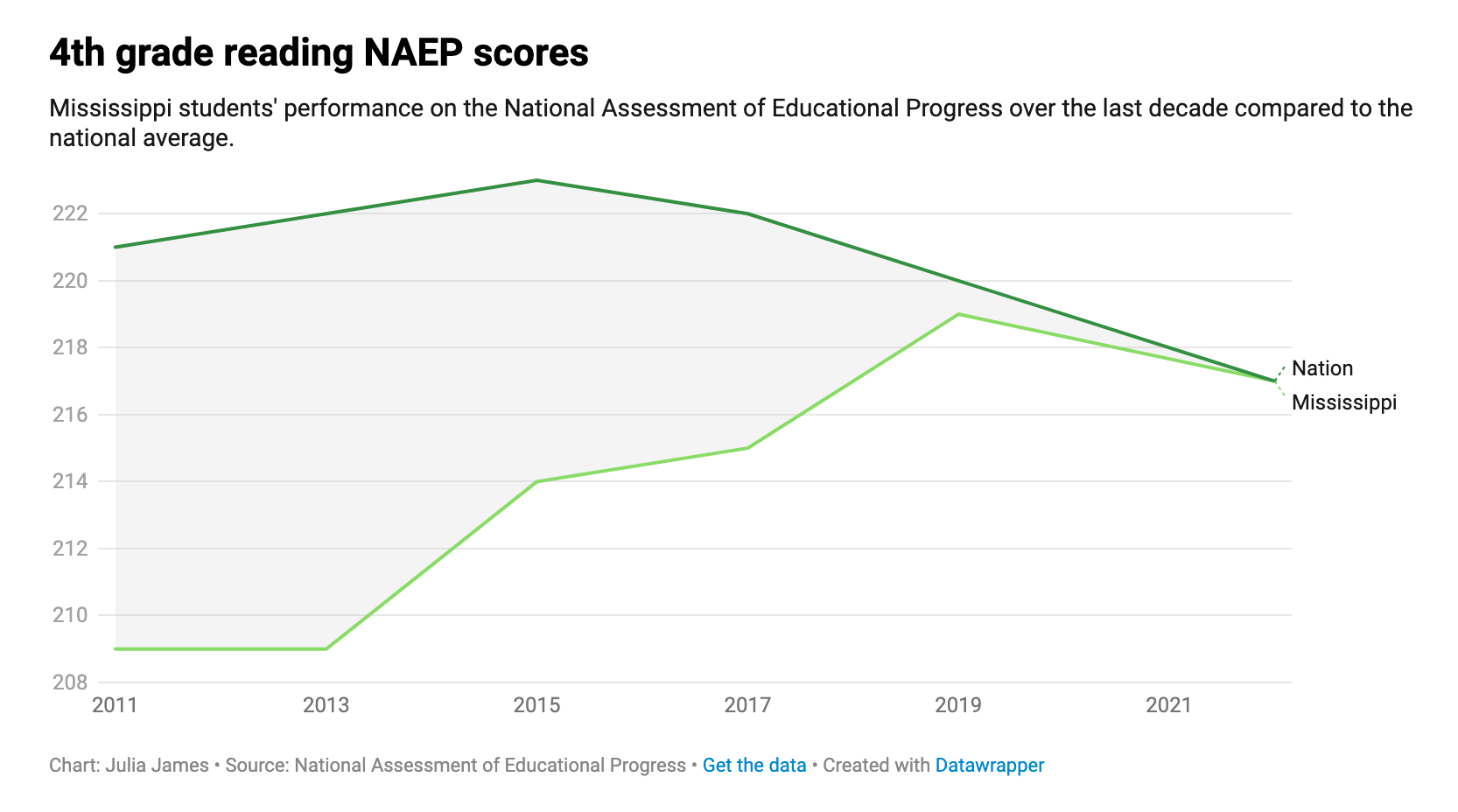
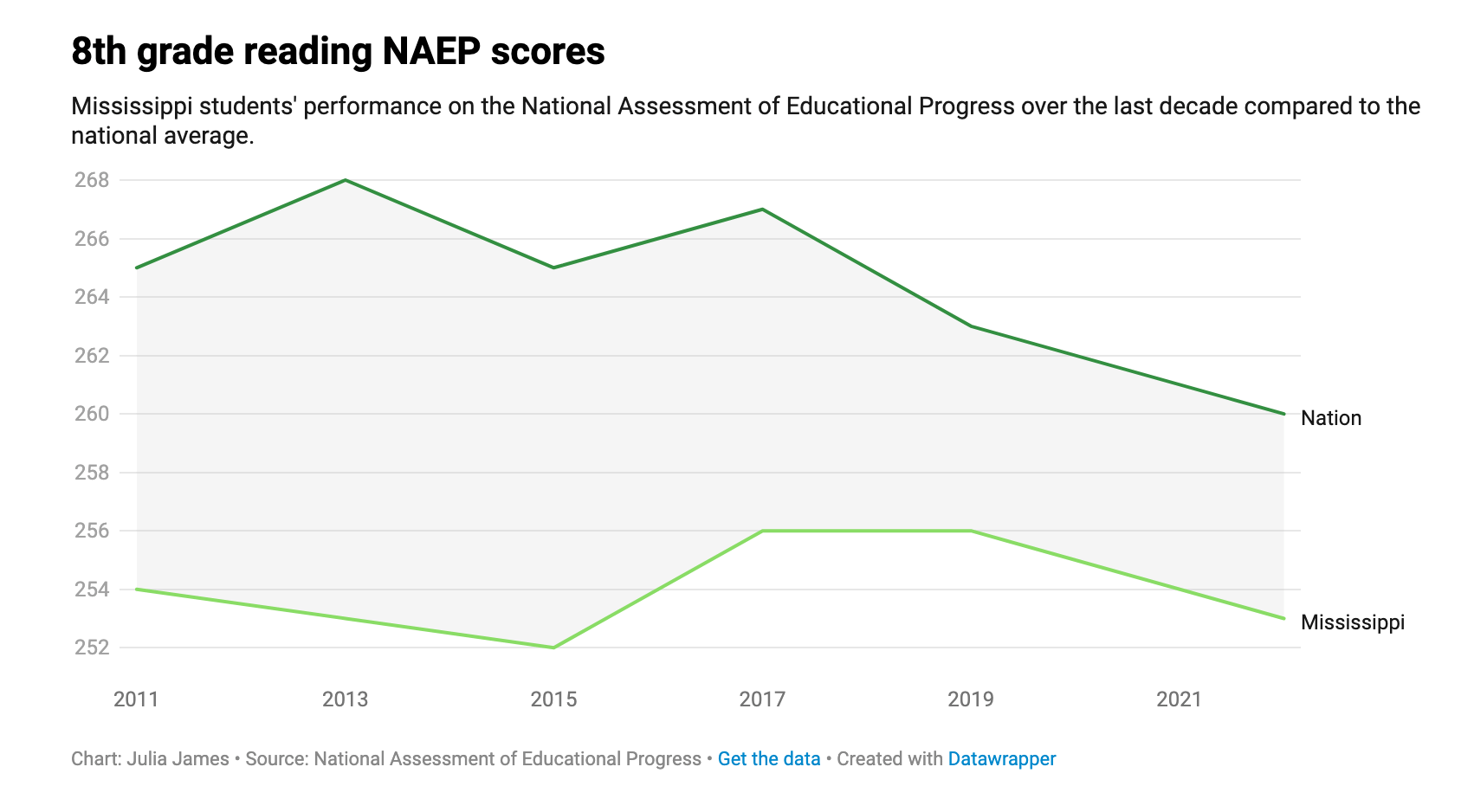
But an even better story is that student achievement among Black and Hispanic students is very complicated, especially when you consider that states have dramatically different percentages of these populations of students.
Further, if we return to the parable from the opening, even better data at grade 8 is not the full picture.
In MS and throughout the US, Black students are still suffering the consequences of the persistent race gap in achievement (most states have the same gap as 1998, including MS).
And Black Americans remain trapped in the burden of racial inequity both in schools and in their communities.
The misleading stories about MS using grade 4 NAEP data are designed to promote a “beating the odds” story—one that isn’t true—but all students in the US would be better served if we chose not to seek those who beat the odds, but to change the odds so that no one—especially children—would have to overcome those inequities in the first place.
Michigan Update
This Washington Post Op-Ed falls for the Mississippi “mirage” to criticize Michigan literacy policy not including grade retention: Gretchen Whitmer’s failed literacy test.
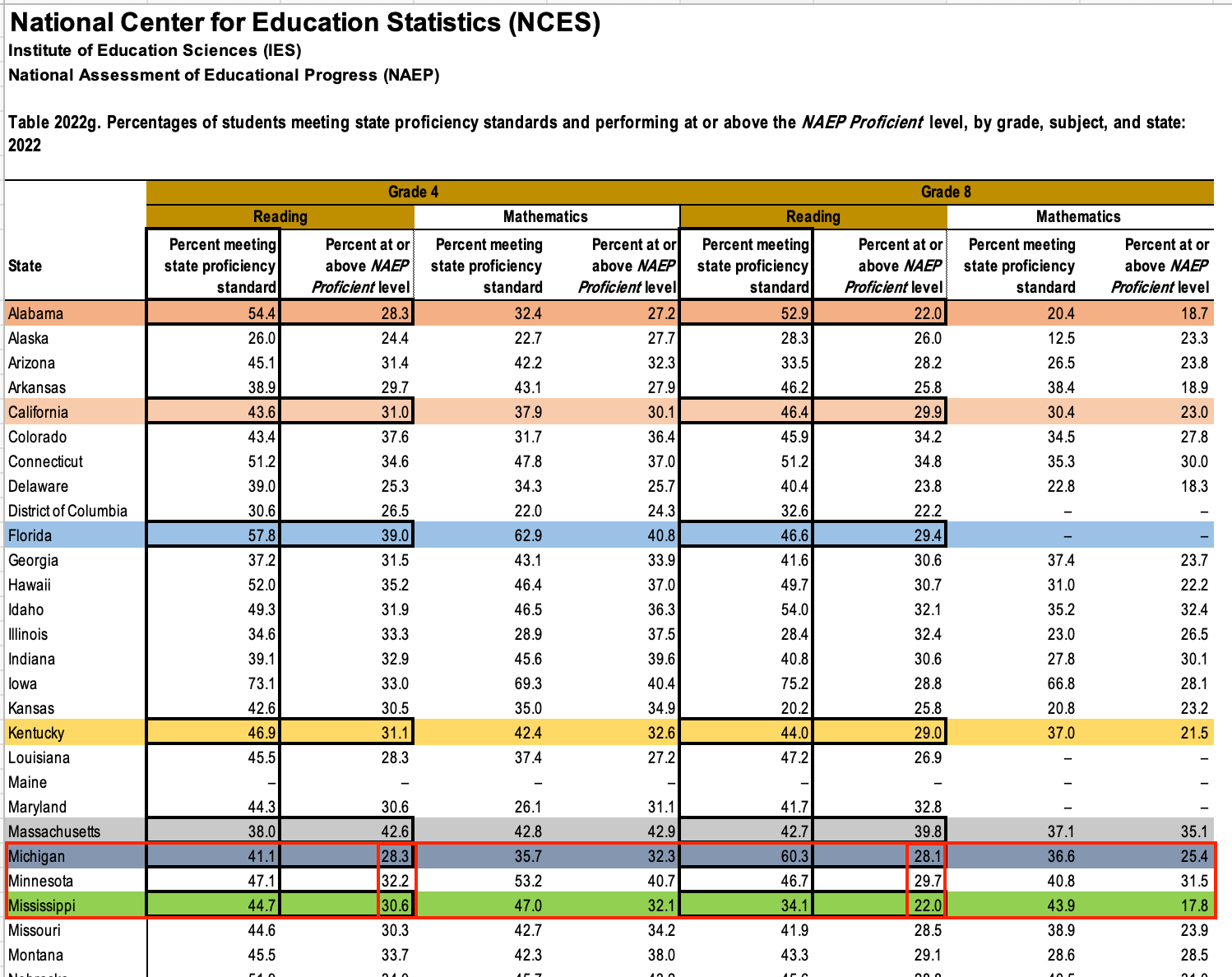
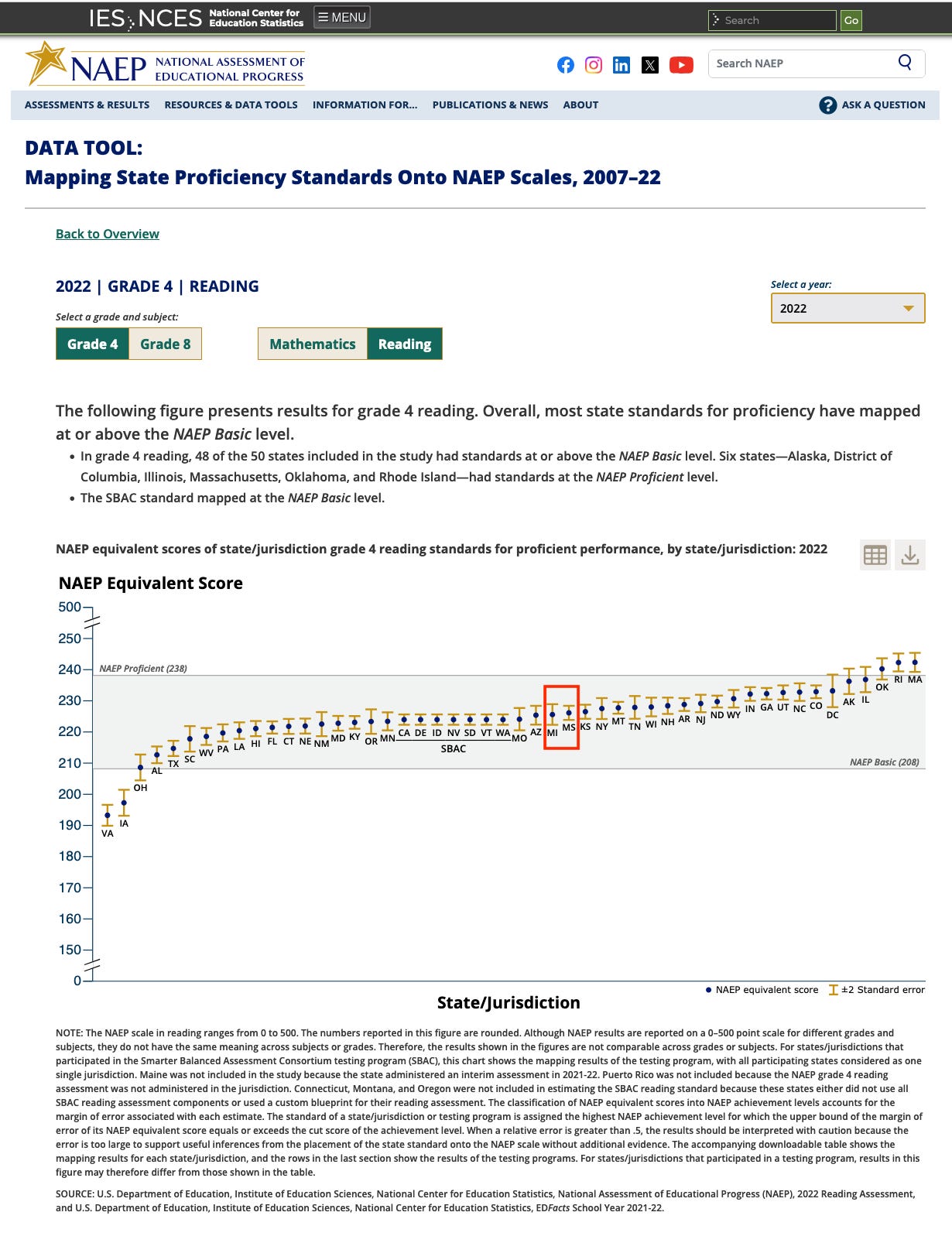
A simple NAEP comparison from grade 4 to grade 8, however, exposes the mirage; MI behind MS in grade 4 but ahead in grade 8:
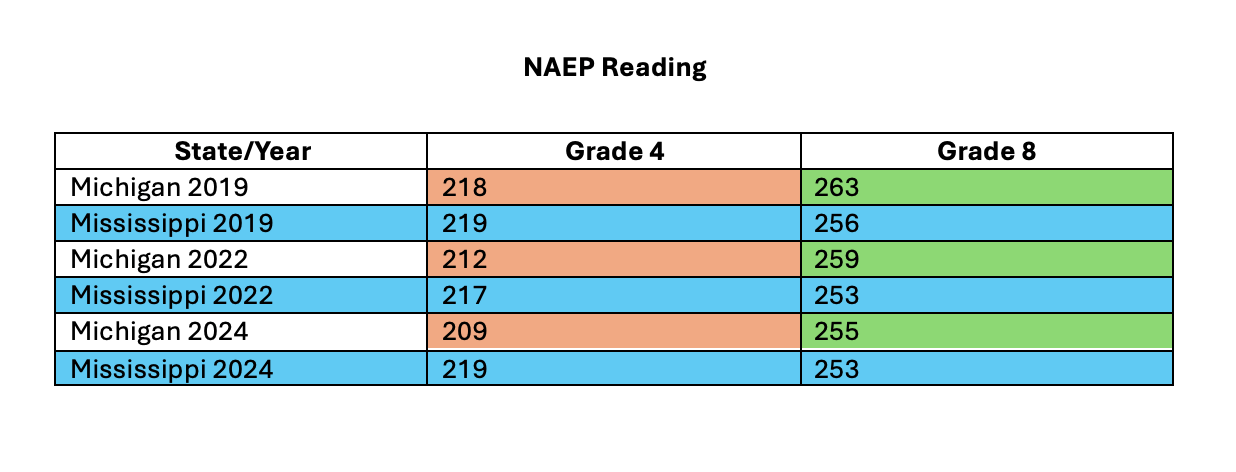
See also MI behind MS at grade 4 proficient at or above, but ahead by grade 8 [note that MI and MS have similar state proficiency levels that are midway in NAEP “basic”]:
Missouri Update
This phenomenon should now officially be called the Mississippi Mistake: Inspired by Mississippi, Missouri lawmakers want to hold back third graders who can’t read:
It’s just one piece of a broader push in Jefferson City to import the legislation behind the “Mississippi Miracle”—the nickname for the remarkable literacy gains shown by pupils in that Southern state. In 2013, Mississippi fourth graders scored 49th in the nation in reading in the National Assessment of Educational Progress test; by 2024, they’d risen to 9th place. And even that doesn’t capture the magnitude of the achievement, because a student’s wealth background is highly predictive of academic performance, and Mississippi has many low-income students. Once you adjust for that, Mississippi topped the list in reading and math. And this happened over more than a decade, prompting some to prefer the label “Mississippi Marathon.”
Note above MO is behind MS in grade 4 but ahead in grade 8.
Further, the article suggests retention is declining in MS. The following data from Mississippi on reading proficiency and grade retention exposes that these claims are misleading or possibly false:
2014-2015 – 3064 (grade 3) – 12,224 K-3 retained/ 32.2% proficiency
2015-2016 – 2307 (grade 3) – 11,310 K-3 retained/ 32.3% proficiency
2016-2017 – 1505 (grade 3) – 9834 K-3 retained / 36.1 % proficiency
2017-2018 – 1285 (grade 3) – 8902 K-3 retained / 44.7% proficiency
2018-2019 – 3379 (grade 3) – 11,034 K-3 retained / 48.3% proficiency
2021-2022 – 2958 (grade 3) – 10,388 K-3 retained / 46.4% proficiency
2022-2023 – 2287 (grade 3) – 9,525 K-3 retained/ 51.6% proficiency
2023-2024 – 2033 (grade 3) – 9,121 K-3 retained/ 57.7% proficiency
2024-2025 – 2132 (grade 3) – 9250 K-3 retained/ 49.4% proficiency
Alabama Update
Alabama has the fourth lowest proficiency level of any state, at the bottom of NAEP basic; AL has been steadily lowering the proficiency level over the last decade (see years and levels here). AL “proficient”/ NAEP “basic” equivalent: 2022 [213], 2019 [220], 2017 [227], 2015 [235]):
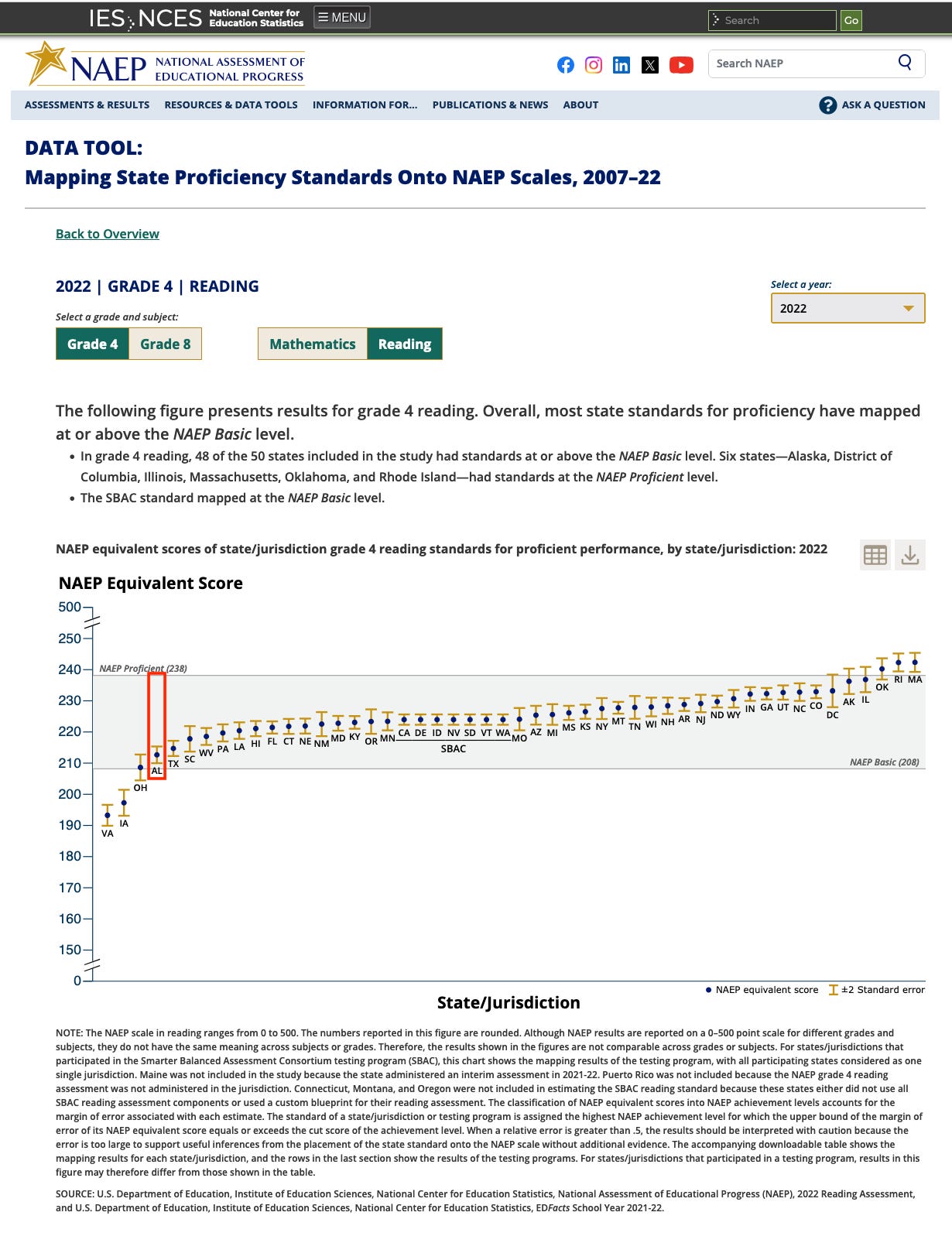
States lowering proficiency scores to increase number of students meeting proficiency is not a reflection of a “miracle” or a “surge.”
Recommended
Test-Based Achievement Mirages: Florida Edition
If you want to help with the costs of keeping my public work open access and free, please DONATE.