Although many people in the US associate the “science of reading” (SOR) movement with Emily Hanford’s journalism and podcasting that started around 2017 and 2018, England implemented systematic phonics for all students in 2006 as foundational to their reading reform.
As the SOR movement in the US has grown, there have been some schisms and reversals, notably the development of the Core Knowledge wing of SOR promoted by Natalie Wexler (spurring a rejuvenation of ED Hirsch) as a part of the “phonics isn’t enough” fracture.
Again, in England, the knowledge and direct/explicit instruction movement is quite strong and has broadened into the “science of learning” (SOL).
In both the US and England, the education experts promoting “science of” arguments for knowledge and teacher-centered direct/explicit instruction are aggressive to the point of being arrogant and just nasty.
I noticed that one of the more aggressive SOL advocates has chosen to mansplain Bloom’s Taxonomy in service of the knowledge argument.
First, this post is right that Bloom’s Taxonomy has been almost entirely misrepresented and misused in mainstream education for decades.
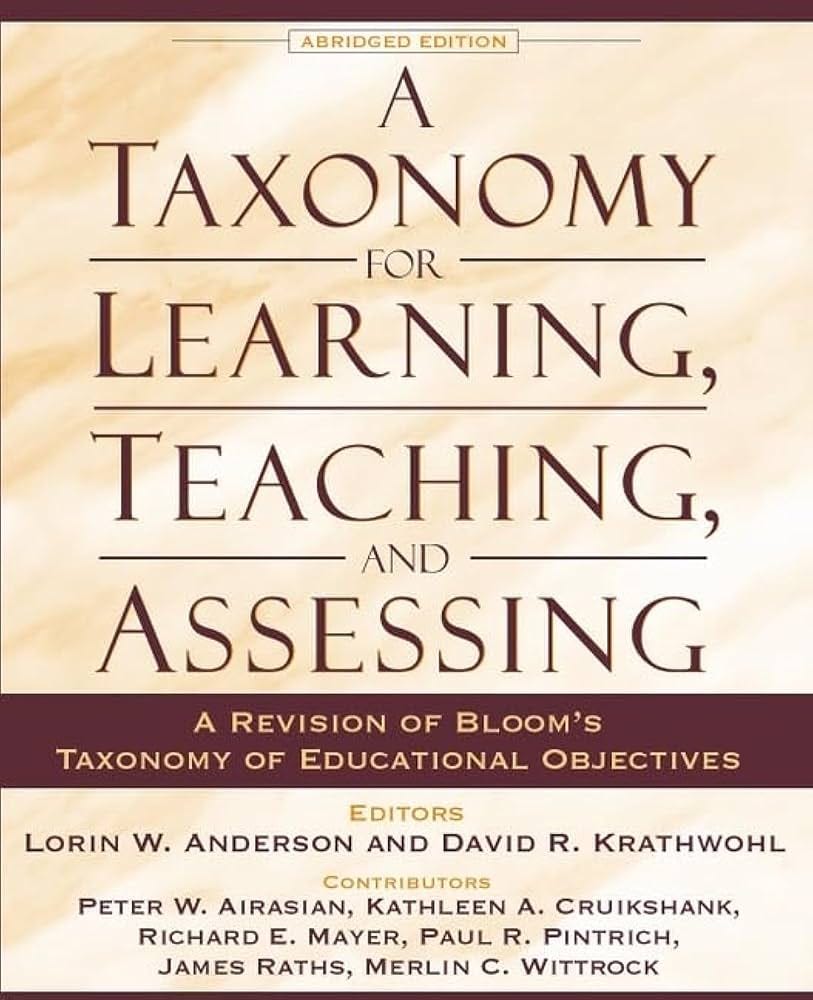
But here is the fun part: Benjamin Bloom was the doctoral chair for Lorin Anderson, who was my doctoral chair.
Anderson has been working much of his career on correcting the record about Bloom’s work, in fact, and if you really want to understand Bloom, I suggest Lorin’s career-long effort (not a blog post from SOL advocates with many agendas).
In short, Lorin cautions that Bloom’s taxonomy has been used for many purposes for which it was never intended, and possibly more importantly, the triangle that never appeared in Bloom’s work has served to suggest a hierarchy of learning (a required sequence) that is false.
Regardless of beliefs about teaching and learning, using Bloom to argue for strict linear approaches to teaching and learning is misunderstanding Bloom.
Now, here is an important point. That misleading but popular triangle is often used as evidence for discrediting direct instruction and marginalizing knowledge; in other words, Bloom’s taxonomy is ideologically and philosophically weaponized.
The SOL effort to do the same thing but for a different agenda is just as flawed.
The irony here is that the arguments for knowledge and direct/explicit instruction are not science-based arguments but philosophical ones.
The SOL movement is using “science” as a veneer for Essentialism, a back-to-basics and core knowledge philosophy of education. [1]
Another irony here is that the 6 categories created by Bloom and then revised by Lorin and Krathwohl are intended to show the holistic nature of learning (something at the core of the maligned whole language approach to literacy). Each of the six categories work for and with each other; it is not that one leads to the other as many misinterpret.
Here is a pretty simple example of what I mean.
When I was writing my dissertation for Lorin and my committee, reading, researching, and then writing was an act of creating and evaluating (revised Bloom) or evaluation and synthesis (triangle Bloom) that required me to analyze and apply knowledge but through the creative act I also gained new knowledge (knowledge that wasn’t a mandatory aspect I had to acquire before the creative act).
Ultimately, however, the many versions of “science of” education reform agendas and policies must be recognized for what they are—mostly anecdotes, ideological and philosophical claims, and a heavy dose of education marketing.
The “science” just is rarely there, and this newest effort to co-opt Bloom is another example of putting beliefs before the evidence.
Note
[1] See these resources if you’d like to understand more:
Assorted readings on Essentialism.
See Chapter 3. Educational Philosophies
Recommended
A Look Back: Guest Post From Lorin W. Anderson, Co-Author Of The Revised Bloom’s Taxonomy
What Every Teacher Should Know: Reflections on “Educating the Developing Mind,” Lorin W. Anderson
If you want to help with the costs of keeping my public work open access and free, please DONATE.